
The sales inbox has a familiar problem: an enquiry arrives with an attachment, someone checks the catalogue, another person looks for a delivery note, and the customer waits. An AI agent sounds attractive here. The difficult part is deciding whether its job ends with finding information, drafting a reply or actually making a commitment.
Give the agent an observable finish line
OpenAI’s March 11 release introduces the Responses API, built-in tools and an Agents SDK with tracing. These are practical building blocks for work that crosses several steps. They do not define what a completed job means for your business. That definition belongs in the service design before the tools are connected.
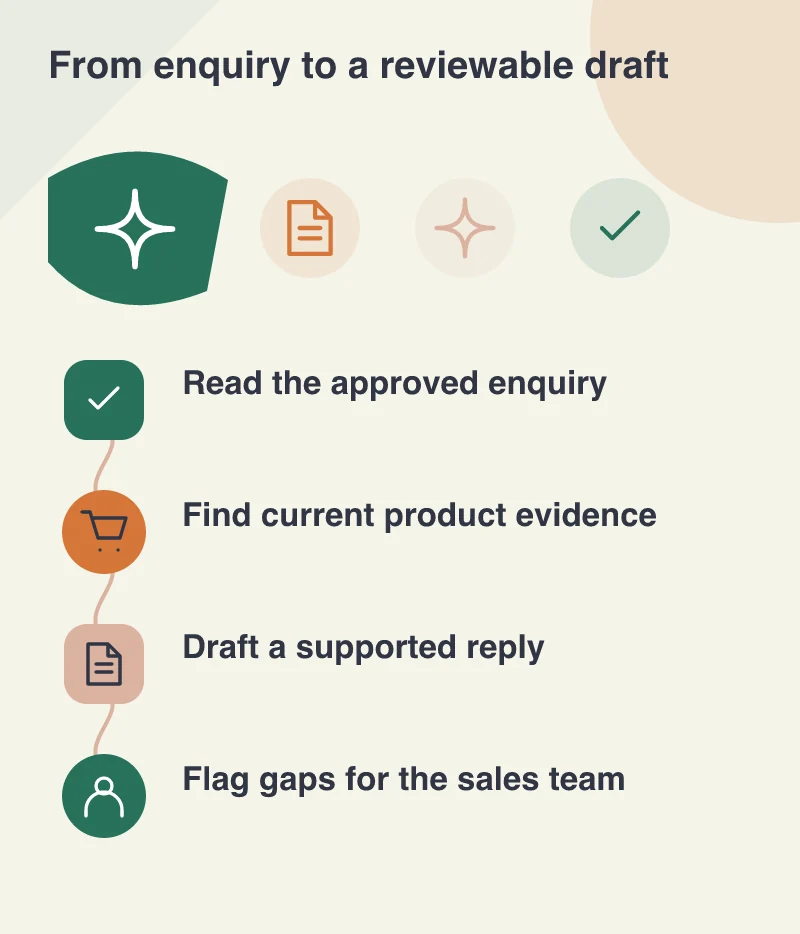
For an enquiry assistant, completion might mean a draft containing the requested product, evidence for its specification and an explicit list of missing information. Sending a quotation is a different permission. Combining the two because the demo looks smoother makes it harder to spot where an information task becomes a commercial decision.
Follow the work through an exception
Imagine a distributor receiving a request for a pump suitable for an unusual operating temperature. The assistant finds two similar products, but only one has a current technical sheet. A good outcome is not a confident selection from incomplete evidence. It is a clear explanation of the gap, attached to the enquiry that a specialist can open.
Build that example into the first demonstration. It reveals whether the agent can stop, preserve its useful work and hand responsibility to the right person. A system that completes ordinary requests but loses the difficult ones can simply move the inbox problem somewhere less visible.
Make the action history readable
Tracing is useful when a developer needs to understand why the agent took a particular route. Operations staff need a shorter view: which records were read, what was proposed, what was changed and who accepted the result. Keep a connection between that summary and the underlying execution history.
Avoid presenting every internal step as another customer notification. Show meaningful progress, then a stable result. If an external service is unavailable, the interface should explain whether the task is waiting, failed or ready for manual completion. Re-running an ambiguous task should not silently create another customer record.
Start where the result can be checked
Choose a pilot with known inputs and a human-readable output. Run representative enquiries through it, including outdated attachments, contradictory product names and requests outside the approved scope. Judge the result against the work your team would actually accept, rather than the number of tool calls completed.
A small assistant that reliably prepares a useful handover can earn a place in daily work. Expanding its authority should follow evidence from that work, with a separate decision for each new action it is allowed to take.