
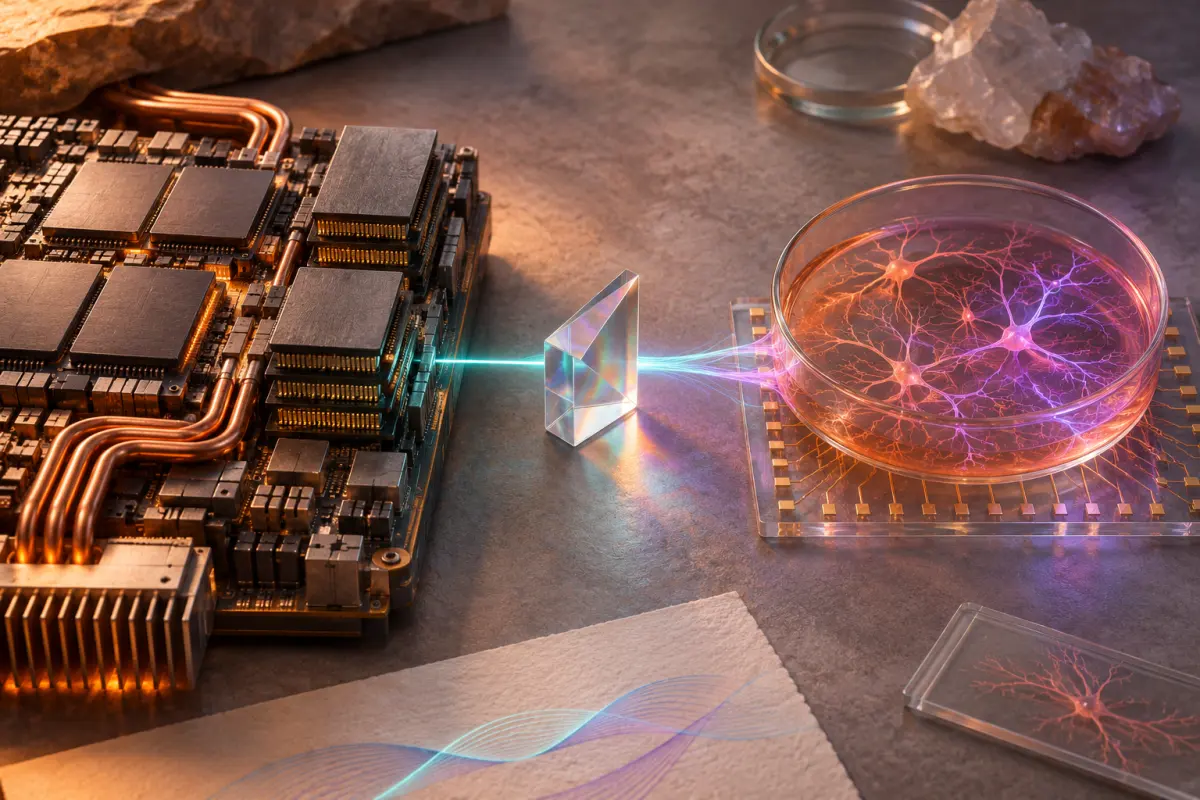
The question that started this article was practical: if 600 square feet were converted into an AI data centre, how much computing capacity would fit, what would it cost, and how much work could it produce beside cloud AI? That deserves a numerical answer before we discuss a different kind of computer.
A sensible planning model is four NVIDIA GB200 NVL72 compute racks, with the remaining space used for coolant distribution, power equipment, networking, storage, safe access and maintenance. More cabinets could be drawn on a floor plan. The difficulty is feeding and cooling them. Four racks already take the room into half-megawatt territory.
That calculation is not a diversion from the idea of a different computer. It is the reason to take the idea seriously. Today we improve AI by multiplying expensive silicon, memory channels, electricity and cooling. Wetware computing asks whether part of the learning and adaptation can happen in living cells instead.
What 600 square feet can hold today
NVIDIA documents one GB200 NVL72 rack as 72 Blackwell GPUs in a single NVLink domain, with an approximate load of 120 kW. Four racks therefore provide the following planning envelope:
- 288 Blackwell GPUs and 144 Grace CPUs.
- About 53.3 TB of high-bandwidth GPU memory, using the 13.32 TB published for one 72-GPU system.
- About 480 kW of compute-rack load before the facility overhead for pumps, heat rejection, power conversion, storage and networking.
- About 576 kW at the building supply under a worked PUE assumption of 1.2. That is roughly 5.05 GWh a year if the room runs continuously.
The cabinet footprints themselves use only a small part of the floor. The rest of the 600 square feet is working space, not spare compute capacity. A design still needs structural, electrical, fire and mechanical approval; a normal office room with enough area is not automatically a data centre.
A realistic cost envelope
NVIDIA does not publish a simple retail price for the complete rack. A March 2026 industry report placed a GB200 NVL72 at roughly $2.8 million to $3.4 million, depending on configuration. Four compute racks alone are therefore about $11.2 million to $13.6 million. These are reported estimates, not a published NVIDIA list price or a binding quotation.
For an early business case, I would add a provisional 50% to 100% project allowance for scale-out networking, storage, the electrical service, liquid-cooling plant, controls, commissioning, safety work and local construction. That produces an initial envelope of approximately $16.8 million to $27.2 million, before tax, land, finance, staffing and major spares. The allowance is deliberately broad: an existing high-density facility may spend less, while converting an ordinary office shell may spend more.
Electricity remains a separate operating cost. At the worked 576 kW facility load, the room consumes about 5.05 million kWh a year. Multiply that by the local tariff: at ₹10 per kWh it is roughly ₹5.05 crore a year; at $0.10 per kWh it is about $505,000. Maintenance, cooling water where used, network transit and the people running the service sit on top.
How much output could it generate?
There is no honest universal tokens-per-second figure for a room. Output changes with the model, precision, input length, batch size, latency target and serving software. We can, however, use one verified reference point. In an MLCommons endpoint result, one GB200 NVL72 serving DeepSeek-R1 reached 441,740 output tokens per second at 16,384 concurrent queries, with a 404 ms 90th-percentile time to first token and 27 output tokens per second per user.
Four independent racks at the same measured rate would be about 1.77 million output tokens per second. At 50% sustained use, the arithmetic is roughly 2.29 trillion output tokens in a 30-day month. This is a capacity benchmark, not a promise for an ordinary private chatbot: a quieter system, a longer context, a different model or fewer simultaneous users will produce a different result.
The same capacity in the cloud
Cloud hardware does not create extra arithmetic merely because it is rented. Four equivalent, fully occupied rack-scale systems should deliver the same order of raw output whether they stand in your facility or a provider’s. The cloud advantage is that the provider already owns the building, power, cooling, network and operations, and can combine demand from many customers.
CoreWeave currently lists a four-GPU GB200 NVL72 instance at $42 per hour. Eighteen such nodes make one 72-GPU rack, so four racks are $3,024 per hour, about $2.21 million for a 730-hour month or $26.5 million for a full year at the public on-demand rate. At 25% actual use, capacity that can genuinely be released after each job costs about $552,000 for the month instead. The owned room still carries its capital cost while it waits. Reserved cloud contracts can be cheaper, while storage, network traffic and managed services can add cost.
A commercial AI API is not directly comparable with either number. Its price includes a provider’s model, optimisation, safety layer and shared fleet, and the provider does not dedicate a known fraction of a rack to one customer. The fair comparison is a measured workload: the same model, input length, quality target, response time and monthly volume on both sides.
This calculation also explains why utilisation matters. Our earlier article on the AI compute dilemma looks at that issue from the provider’s side. Here it exposes the architectural question: should greater intelligence always require a larger electrical and cooling system?
The different computer is already being tested
Wetware is biological material used as part of a computing system. A useful overview from Intelligent Living describes three active branches: engineered bacteria arranged as logic, fungal material showing memory-like electrical behaviour, and living neurons coupled to electrodes. They do not compete for the same job, and none is a biological replacement for a laptop.
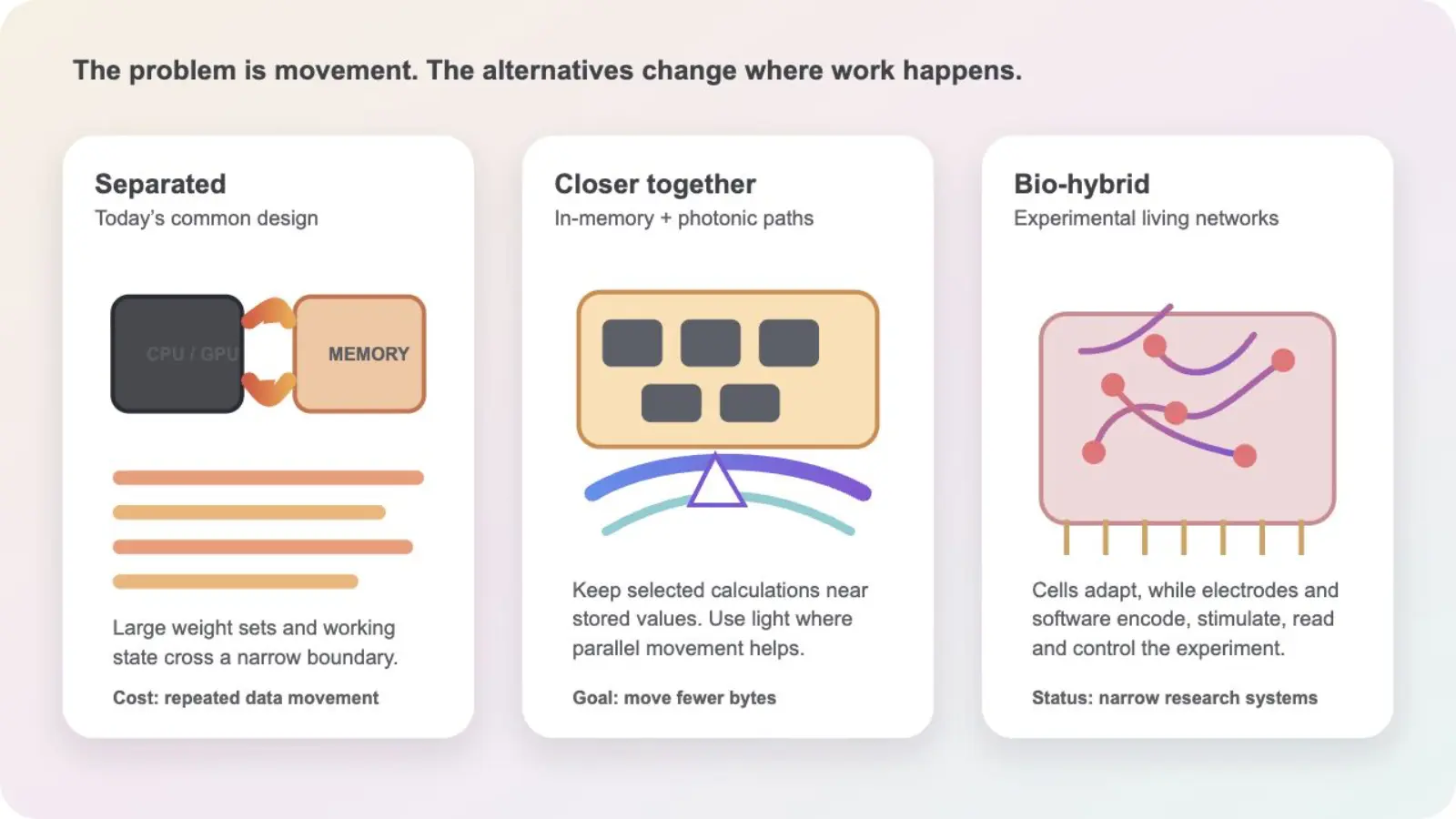
The neural branch is the closest to the question behind this article. A digital neural network stores learned parameters and repeatedly moves them through electronic hardware. A living neural network changes the strength and structure of its own connections as it receives stimulation. The memory and the processing are not separated in the same way. That does not make it faster at every task; it creates a different kind of adaptive element.
Cortical Labs puts living neurons behind a developer interface
Cortical Labs has moved this idea beyond a dish that only its inventors can operate. Its CL1 grows neurons across a silicon chip containing electrodes. Software sends electrical stimulation into the culture, records the spikes that come back and changes the next input. The living network is therefore inside a closed loop with an ordinary computer.
The important word is hybrid. The neurons do not receive a sentence, a photograph or a price chart directly. Silicon converts the outside event into patterns of stimulation. It records the response, timestamps it and decides what action follows. Cortical’s own developer guide exposes this through a Python API for recording, reading, stimulating and running timed closed-loop experiments at iteration rates up to 25 kHz. Developers can use a simulator before sending the same style of code to a physical CL1.
The CL1 product description says its recordings, applications and life-support functions are contained in the device, and that its environment is designed to keep the neurons alive for up to six months. Cortical Cloud offers remote access to arrays of CL1 units for people who do not operate a cell-culture lab. Those are meaningful steps toward a usable research platform. They are vendor specifications, not proof that a CL1 can replace an LLM server.
A 20-unit biological computing rack is now operating in Singapore
In August 2026, NUS Medicine, data-centre operator DayOne and Cortical Labs unveiled a 20-unit CL1 prototype at the NUS Life Sciences Institute. NUS describes it as the first independently operated biologically integrated server rack. The cells are grown under the supervision of its neurobiology team, while DayOne provides the data-centre operating context.
This is important because it tests more than a biological chip. It tests how cultures, life support, monitoring, software and conventional infrastructure behave as a service. DayOne says the first work will concentrate on performance and efficiency benchmarking, with possible future use in biomedical modelling, drug discovery and neurological research. That is a more accurate description than calling it a general-purpose AI data centre.
The Intelligent Living report estimates about 200,000 neurons and roughly 30 watts per CL1, but those figures should not be turned into a GPU comparison. A GB200 rack has a verified language-model throughput; the CL1 does not yet have an equivalent tokens-per-second result on the same model and quality target. Thirty watts doing a different experiment is not automatically more efficient than 120 kW serving millions of tokens. The potential is in learning from sparse signals and adapting with fewer examples, not in winning a benchmark it has not run.
What the neurons have actually demonstrated
In the 2022 DishBrain study, human- or rodent-derived neurons received information from a simulated Pong game through a high-density electrode array. Their activity affected the paddle, and their performance changed under structured closed-loop feedback. The experiment showed adaptation inside a deliberately built interface. It did not show language understanding, consciousness or a general computer.
An October 2026 Braille classification experiment provides another useful boundary. Tactile data became electrical stimulation, organoid activity was recorded, and a conventional support-vector machine classified the result. One organoid averaged 61% accuracy and three together reached 83%. The direct clean-input control reached 82%; the three-organoid system became more interesting under the tested noise, where its response was more robust.
That is not a biological replacement for the classifier. It is evidence that living tissue can transform a signal in a way that may become useful inside a hybrid system. The practical research question is now sharper: which tasks benefit from adaptation, variation and sparse examples enough to justify the biology around them?
Wetware extends beyond neurons
In August 2026, MIT researchers reported living circuit boards made from engineered bacterial colonies. Five strains acted as switches and relays, allowing circuits including logic gates, routing and a two-input adder. A calculation took about eight hours. That is useless for a web request and potentially acceptable on a plant root that senses stress over a growing season. The substrate changes the job as well as the speed.
A 2025 study of shiitake mycelium found memristive behaviour—an electrical resistance influenced by prior stimulation—and demonstrated switching up to 5.85 kHz at 90% accuracy in its test. The samples could be dehydrated and later rehydrated. This is early device research, but it suggests biodegradable memory and sensing components rather than a mushroom running desktop software.
Bacteria, fungi and neurons make the phrase ‘living computer’ sound like one field. In practice they offer very different properties: chemical sensing, memory-like behaviour or adaptive neural response. The likely future is a set of specialised biological components beside silicon, not one wet machine replacing every processor.
Silicon is also being redesigned from within
Wetware is the most radical route, but it is not the only attempt to stop moving so much data. Processing-in-memory research puts selected calculations beside the stored values. A 2025 analog in-memory attention demonstration targeted the growing traffic created by the key-value cache in language models. These approaches retain electronic precision and a familiar software path while changing where the arithmetic happens.
Photonic accelerators use light for highly parallel matrix operations. A 2025 Nature demonstration ran models including BERT, but it remained a hybrid system: data conversion, memory, control and some operations stayed electronic. That is the common pattern. The new substrate does the part it suits; silicon holds the system together.
The limits are part of the invention
Living processors replace familiar engineering problems with biological ones. Cultures vary, drift and eventually need replacement. They require sterile nutrients, controlled temperature, gas exchange, waste management and continuous health monitoring. A programmer can inspect a register; a living network does not expose itself so neatly. Reproducibility and calibration are central work, not finishing details.
There is also a moral boundary. Neural organoids are models of aspects of brain tissue, not miniature people, and current experiments do not justify casual claims of consciousness. Even so, increasing their complexity without governance would be irresponsible. The Nuffield Council on Bioethics identifies consent, oversight and future functional complexity as questions that should be addressed before capability forces the issue.
Dense biological storage must also be kept separate from biological computation. DNA has extraordinary theoretical information density, but a review of synthetic DNA storage describes slow writing, difficult random access and rewriting constraints. A small object that stores a vast archive is not automatically a fast thinking machine. Capacity, bandwidth, latency, compute and learning remain different properties.
What I would build—and what I would research
For a business that needs private AI now, I would still begin with the workload. Measure the smallest model that gives acceptable answers, the real context length, simultaneous users and response time. Rent one representative system, measure it for a month, and only then decide whether steady utilisation and data-control needs justify owned hardware. Do not turn 600 square feet into a $20 million assumption.
For the different-computer programme, I would not ask wetware to reproduce an LLM first. I would choose a narrow adaptive problem with sparse examples and a measurable feedback loop: detecting a changing anomaly, responding to a biological signal or learning a small control task. I would compare it with a simple electronic baseline and count the entire system, including life support and the silicon interface.
The four-rack room and the 20-unit biological rack are not competing products in 2026. One can serve a large language model today; the other is a research platform for discovering whether living networks offer a useful kind of learning. Putting their scale, output and limits beside each other makes the real opportunity clearer.
AI may indeed need a different computer. The first version is unlikely to be a clean replacement for the data centre. It will be a hybrid: silicon for exact control and communication, memory close to calculation, light for selected parallel work, and living cells where adaptation is worth the biological complexity.
If you are weighing local models, cloud inference or an experimental private platform, start with one workload we can measure. That keeps the infrastructure honest and leaves room to test what a genuinely different computer can add.