
A team can send more AI messages without completing more useful work. They may be exploring ideas, correcting the same output or repeatedly rebuilding context. Adoption becomes more interesting when the result can move into an existing process: an accepted draft, a checked catalogue update or a research brief another person can use.
Choose a unit of useful work
OpenAI’s August 12 enterprise report describes a move from assistance towards delegated execution, with company context and shared workflows playing a role. The practical lesson for a business is to define what it wants to accept from an AI system, rather than treating usage volume as the goal.
For a product-content team, the unit might be a reviewable product draft with required fields, evidence and missing information clearly identified. For customer service, it might be an enquiry summary that lets the assigned colleague continue without rereading the entire exchange.
Count the review that remains
A generated draft is not finished merely because it exists. Inspect how much correction, fact-checking and formatting the next person needs to do. An attractive output that requires reconstruction can consume more attention than a modest draft with a reliable structure.
Imagine an operations team preparing a weekly exception report. The assistant collects the relevant records and groups them by agreed categories. The reviewer should be able to inspect the supporting records and correct a classification directly, rather than rebuilding a presentation before the meeting.
Keep the original workflow as a comparison point. The question is whether the new process helps people complete that work more comfortably and accurately, not whether it produces a larger document.
Share the method, not only the prompt
A repeatable workflow includes the input, approved information sources, expected output and review decision. A prompt is one part of that arrangement. When a capable employee finds a useful method, document the surrounding steps so colleagues can reproduce it.
Give the workflow an owner who can update it when the business changes. An outdated instruction shared widely can spread the same error more efficiently. A small, maintained set of useful workflows is a better starting point than a large folder of unowned experiments.
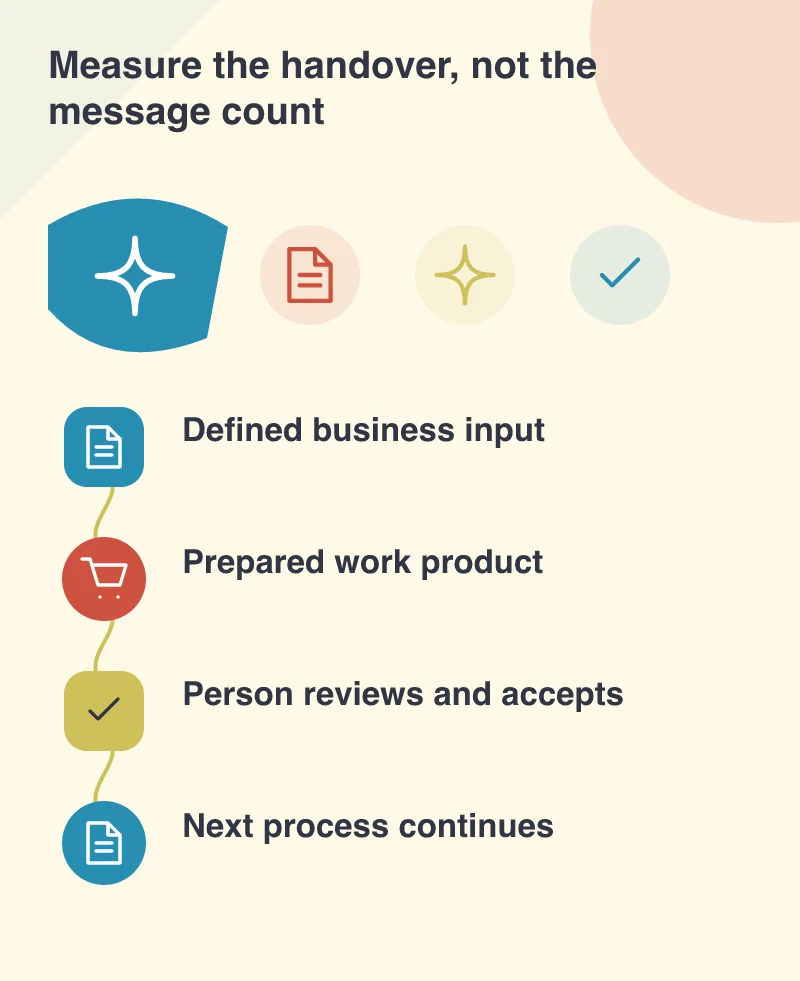
Look for a practical change in the handover
Ask the recipient whether the output is easier to inspect, whether key information is missing and whether it reaches the right place. Those observations can guide the next improvement without claiming a return that has not been measured.
The strongest adoption story is understandable to the people doing the work. An input arrives, useful preparation happens and a colleague can confidently continue. That is a more meaningful target than encouraging everyone to send another message.