An AI assistant can spend a long time researching, drafting and revising a piece of work. Then the conversation becomes too large, the session changes or another person needs to continue. If the important decisions exist only somewhere in the chat, the work is difficult to hand over even when the model has a larger memory.
Treat the work product as the centre
Anthropic’s February 5 launch of Claude Opus 4.6 includes context compaction for longer-running API tasks. It is an interesting way to manage extended work. The product-design question remains separate: what durable record should exist when a session ends?
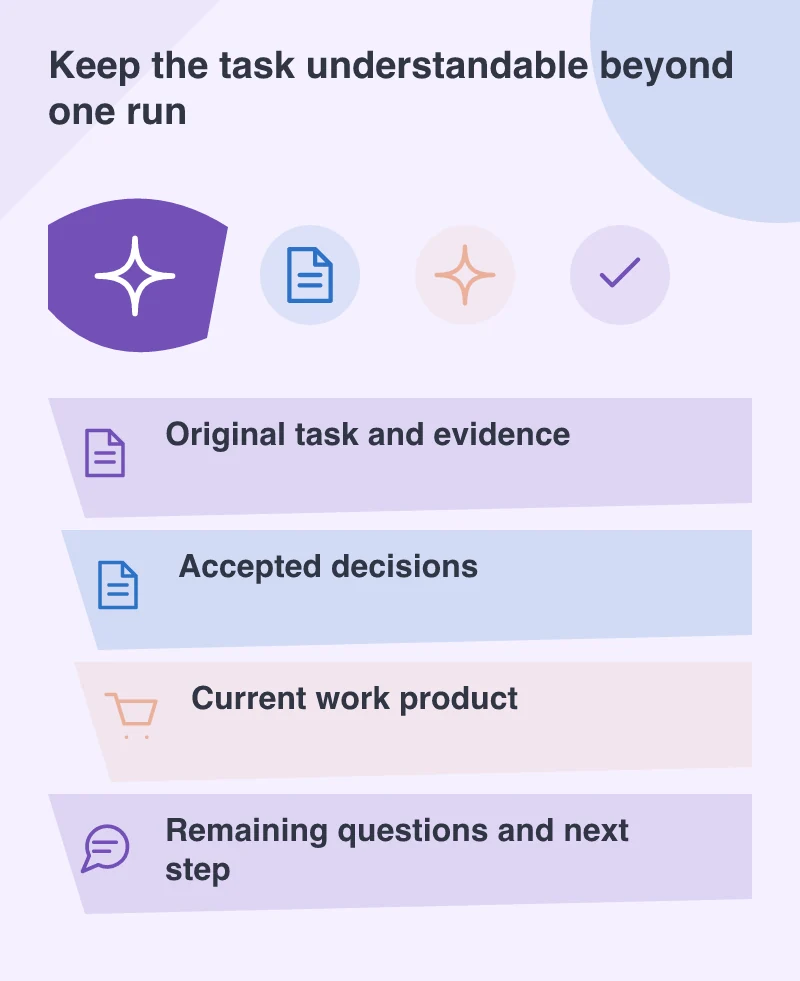
For a research assignment, keep the brief, collected evidence and current draft in an understandable structure. Record the decisions that shaped the output. The conversation can help produce those materials, but it should not be the only place where someone can discover what has been agreed.
Summarise decisions, not just activity
“Reviewed several options” tells the next person very little. A useful handover says which options remain, why others were excluded and what evidence is still missing. These are the facts needed to continue the work without repeating the entire exploration.
Imagine a team preparing a product-catalogue migration. The assistant has mapped several fields but found an ambiguous unit of measure. Preserve that unresolved mapping beside the affected examples. A summary that simply says the mapping is mostly finished hides the detail that could change the import.
Keep evidence attached to conclusions
A compact memory can lose the distinction between a source statement, an assumption and a later correction. The durable work product should preserve those relationships explicitly. A decision table or short annotated draft can do this without copying the entire conversation.
Give corrections a clear place too. If a stakeholder changes a requirement, update the active brief and mark the superseded assumption. Otherwise, a later session may faithfully continue from an outdated summary while appearing to remember the project.
Keep the next action small enough to be resumed directly. “Continue research” is vague; “confirm which unit the supplier uses for these three records” identifies the remaining decision. That precision helps both another person and another agent continue productively.
Design for another person taking over
Ask a colleague to open the handover without reading the chat. Can they explain the goal, inspect the current result and identify the next useful action? If not, the task still depends too heavily on session history.
Longer context can help an assistant stay productive, but durable records make that productivity usable by a team. The strongest AI workflow leaves behind work that people can inspect, revise and continue. It turns a long conversation into a shared asset rather than a private memory.