

A language model can produce a convincing continuation of text without doing what the person meant. January’s InstructGPT announcement addresses that gap through training with human feedback. For a business exploring language-model tools, the development is interesting because it makes instruction-following more explicit. It does not remove the need to decide what a correct result looks like for the task being proposed.
Separate compliance from truth
OpenAI’s 27 January announcement describes models trained to follow instructions with human feedback and discusses continuing limitations. A response can follow the requested format and still contain an incorrect statement. It can sound polite and still miss a condition that matters to the business.
That distinction should shape the first experiment. Instead of asking whether the model seems impressive in a conversation, choose a narrow task with a result someone can assess. Formatting an approved note and answering an open-ended factual question create different evaluation problems.
Bring examples that can disagree with the demonstration
Imagine a team exploring draft summaries of routine enquiries. Prepare examples with several topics, an ambiguous request and a message containing a detail that should not be omitted. Ask the reviewers to identify what a useful summary must preserve and which additions would be unacceptable.
Use material appropriate for the experiment rather than uploading private customer information casually. The model’s capabilities and the business’s data-handling responsibilities are separate parts of the project. A promising response does not settle the latter.
Make the instruction specific enough to test
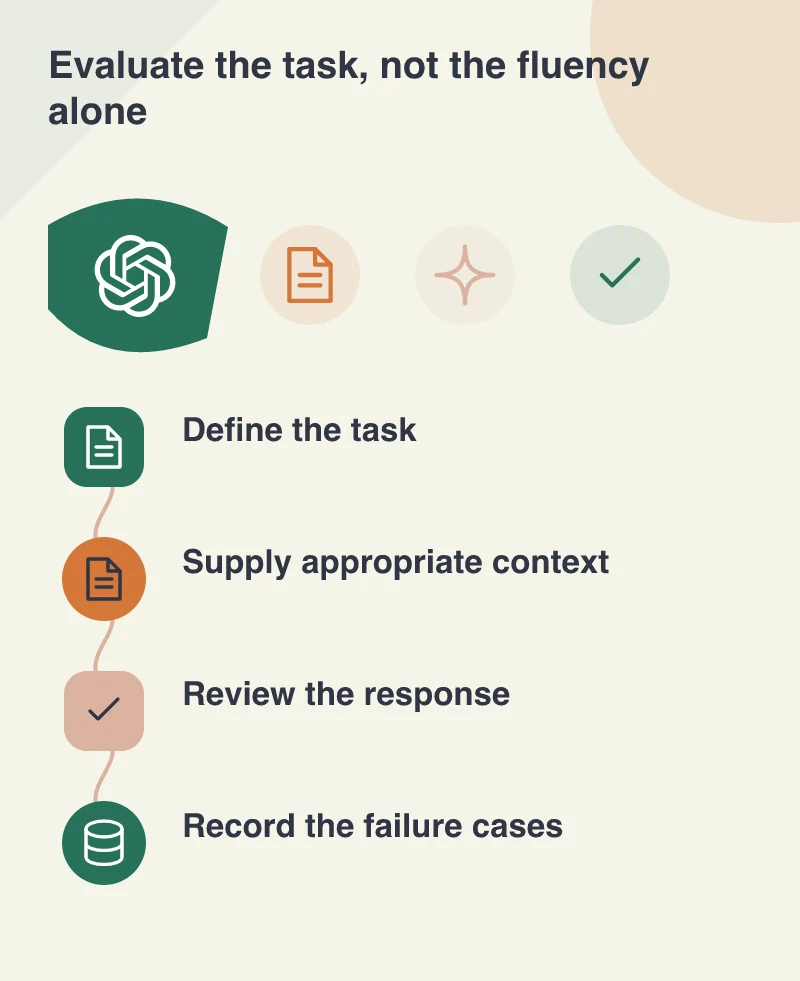
State the intended audience, the information to retain and the form of the result. If the output should not invent a deadline or a commitment, include that in the task definition and review it afterwards. A clear instruction makes failure easier to recognise; it does not guarantee that failure cannot occur.
Keep the original input beside the proposed result during review. A summary that reads well on its own can conceal a missed qualification that becomes obvious only when compared with the source.
Give errors somewhere to go
A reviewer should be able to correct the output and record why it was wrong. Over several examples, those records show whether the problem is a vague instruction, an unsuitable task or a recurring model limitation. That evidence is more useful than selecting the most attractive response for a presentation.
Do not connect the experiment directly to an irreversible business action. A drafted answer and an automatically sent answer have different consequences and deserve different acceptance criteria.
Decide the next step from evidence
The experiment may justify a drafting aid, a narrower task or a different approach. Keep the reviewed examples that led to that decision. They are better evidence for the next iteration than a fluent response selected because it looked convincing in a demonstration.