
An application that can recognise something without waiting for a server response is an appealing idea, especially where a connection is unreliable. TensorFlow Lite’s developer preview, announced on 14 November, brings a lightweight approach to running trained models on mobile and embedded devices. For a business considering a pilot, the most useful starting point is one narrow prediction whose result a person can check.
Training and using a model are different jobs
The preview describes converting a trained TensorFlow model to a format used by the TensorFlow Lite interpreter, initially targeting Android and iOS. It includes examples such as image classification and Smart Reply, with hardware acceleration where supported and CPU execution as a fallback. The announcement is explicit that this is an early, constrained preview, while TensorFlow Mobile remains available for production applications.
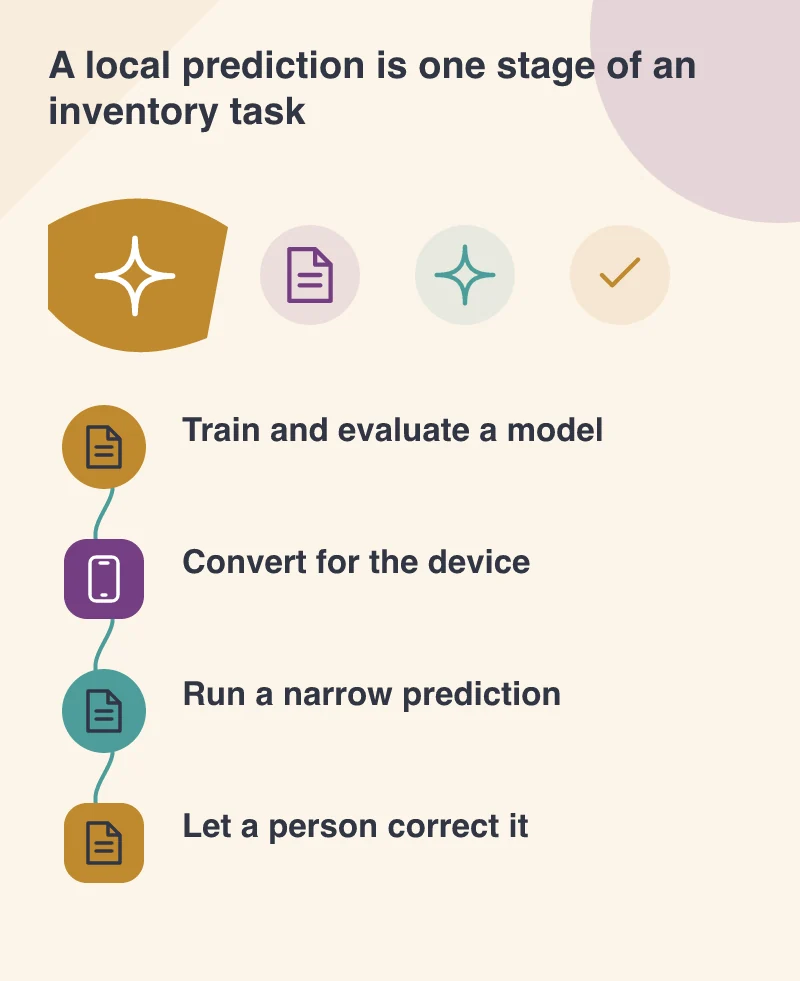
That distinction matters in a project brief. Running a model on a phone does not mean the phone has learnt a new task simply by installing the interpreter. The model still needs suitable training and evaluation. An inventory app, for example, could suggest a broad product group from a photograph, but it should not promise to recognise the shop’s exact catalogue unless a properly tested model actually does that work.
Make uncertainty part of the interface
A useful prediction is not always a final answer. The inventory app might show a suggested group with a clear way to change it, or ask the user to choose when the result is uncertain. The person’s correction should remain part of the saved record. An interface that silently turns a guess into an authoritative product attribute makes it difficult for staff to notice and repair errors.
Evaluate the model with the conditions the app will encounter: uneven lighting, partially obscured objects and the range of cameras used by the intended audience. Keep separate examples that were not used during training. Discuss the business cost of different mistakes instead of relying only on one average score. Misfiling a general browsing category is a different risk from misidentifying a regulated or safety-related item.
Measure the complete mobile cost
Local inference can reduce a network dependency for the chosen prediction, but the application still has storage, startup, memory and battery constraints. Test the whole workflow on representative phones, including loading the model and returning after the app has been interrupted. A model that gives a quick answer on the developer’s newest device may not be a sensible fit for a low-memory customer phone.
Keep the pilot focused: one recognisable task, a limited set of outputs, a human correction path and a record of where it fails. Explain which information is processed locally and which other parts of the application still use a server; local inference is not a blanket privacy guarantee for the entire product. The preview opens a promising technical route. Start with a recognisable question and someone who can judge the answer.