

A storefront can load beautifully while an order fails somewhere the customer cannot see. Payment may be accepted without the expected notification, a stock update may arrive late, or a warehouse export may no longer include a required field. Magento 2.2’s September release is a good reason to define an upgrade check around the order’s entire journey, rather than only around the pages that appear in a browser.
Write the journeys that keep the shop running
Magento’s official repository records the release of version 2.2.0 on 26 September. That milestone does not tell a merchant how its customisations and extensions will behave after an upgrade. Begin by identifying the important combinations in the actual shop: guest and account customers, the shipping methods in use, each payment route and the way an order reaches fulfilment. A test plan should reflect those dependencies.
For an equipment retailer, compare a quote request with a card purchase: the workflows may be quite different. An account customer may see different prices from a guest. A simple product may behave differently from a configurable one. The team should agree which examples represent those differences before scheduling the deployment, so success is not judged from whichever product someone happened to click first.
Follow the record beyond the confirmation screen
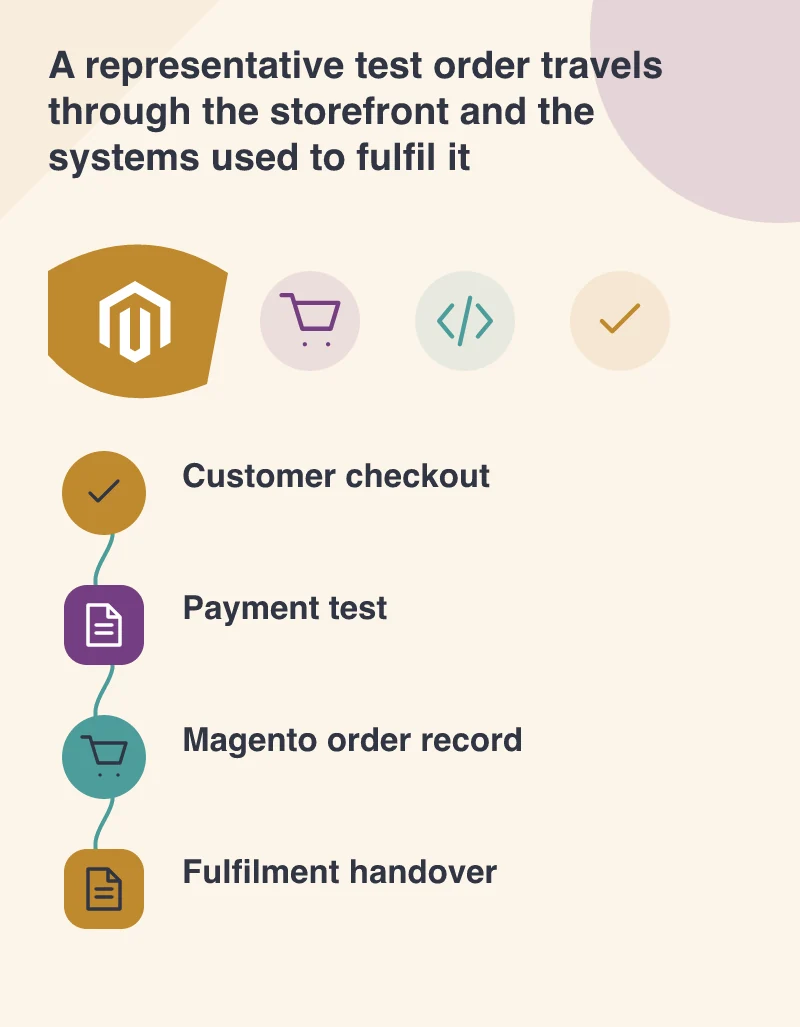
A useful test order has a traceable identity and a clear expected result. Check the customer’s total, shipping charge and confirmation, then inspect the corresponding order in the administrator. Follow the handover to the warehouse or accounting system. If a refund or cancellation is part of normal operations, include that path too. These checks ask whether the business has one coherent order, not merely several screens showing plausible values.
Use the payment provider’s appropriate test environment and keep sample orders clearly separated from real fulfilment. Do not let a staging exercise trigger a genuine dispatch. The integration owner should know how to recognise and remove test records through the normal supported workflow. A technically successful payment test is unhelpful if the operations team mistakes it for work that needs to leave the building.
Agree when an upgrade is ready to leave staging
Record the extensions and custom changes checked, the representative orders completed and any known exception. Ask somebody responsible for daily order handling to review the result. They may spot an incorrect status or missing reference that a front-end developer would not recognise. This is also the point to confirm the deployment window, recovery plan and responsibility for watching the first real orders afterwards.
The value of a new Magento release depends on a shop that continues to trade correctly. Feature exploration can happen alongside this work, but should not obscure it. Keep a tested order map and a small collection of examples that can be repeated for the next release. That makes an upgrade less dependent on confidence in the homepage and more dependent on evidence that the whole business process still joins up.