
A blank planning document can be harder to start than a conversation. You know the rough goal, but not the right questions to ask. OpenAI’s November 30 research preview, ChatGPT, makes that conversation available in a form that can respond to follow-up questions. The appeal is immediate: explain a problem, read a reply, then narrow or correct it. The risk is equally easy to miss. A well-written answer can sound settled when its facts or assumptions are wrong.
Try it on the shape of a problem
Imagine planning a website for a small training business. The initial request is “suggest pages for our website.” A list of standard pages is easy to produce and not particularly valuable.
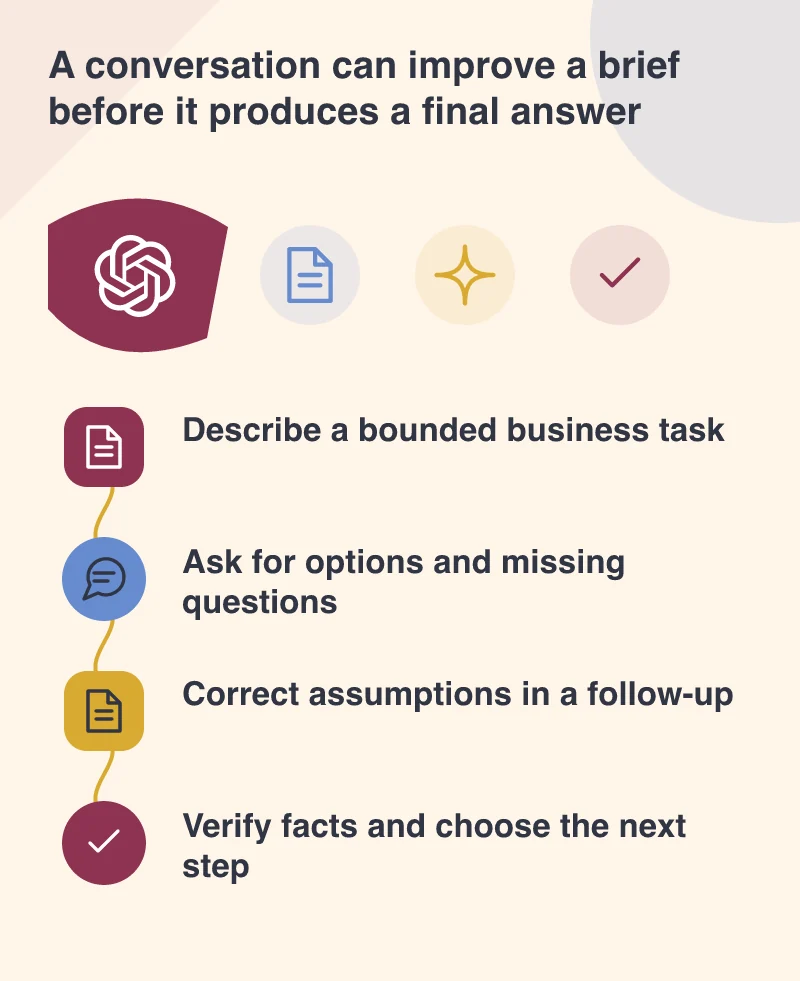
Add context: classes run in several locations, bookings close before each session, and visitors often ask whether beginners can attend. Now ask which questions the site needs to answer before someone books.
The reply can become material for discussion. Ask it to group those questions into a page outline, identify missing information and offer a shorter alternative. The conversation is helping expose the brief, rather than deciding the business’s offer.
Make follow-ups do real work
Do not keep asking for a more polished version of the same general response. Challenge its assumptions. What changes if visitors book for a whole team? Which proposed page duplicates another? What would a first-time attendee still need to know?
Provide corrections when the reply invents a requirement. If classes are in person, remove suggestions built around an online learning platform. Ask for the revised reasoning, not merely a new headline.
Keep the exercise small enough to inspect. A short outline or sample paragraph makes errors easier to notice than a complete site plan generated in one pass.
Move from fluent text to checked decisions
OpenAI’s announcement explicitly warns that ChatGPT can produce plausible but incorrect answers. Treat factual claims as candidates for verification. Check platform capabilities against original documentation and business details against information the team has approved.
For an early experiment, use public or invented example data rather than customer records. There is no need to upload confidential material to discover whether the conversational approach helps with a brief.
A draft should also sound like the business, not simply like a complete answer. Replace generic claims with the details that distinguish the service, and remove promises nobody has agreed to deliver.
ChatGPT’s first value for many teams may be helping them ask what they have not yet considered. Keep the conversation exploratory, the evidence visible and the final judgement human. A better question is a worthwhile result even when none of the generated wording reaches the website.