

A model that writes a convincing answer is not necessarily a model that knows your returns policy. GPT-4’s announcement this March creates plenty of room for experimentation, but a business does not need to begin with an autonomous assistant handling everything. A small, checkable task can reveal more about the technology’s usefulness than an impressive conversation with no defined outcome.
Give the trial a narrow job
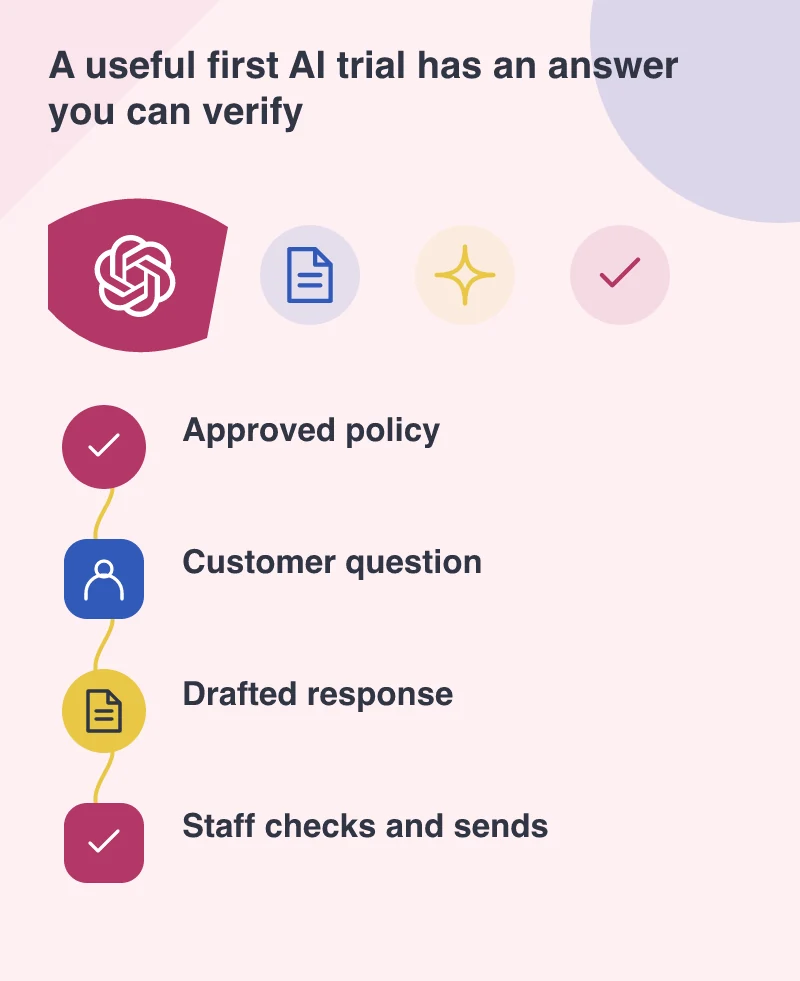
Consider a support team answering repeated questions about a delivery policy. A reasonable first experiment is to turn approved policy text into a draft reply. The task is specific: use the supplied information, answer the customer’s question and leave the final decision to a staff member. It is not to invent exceptions or interpret a contract.
OpenAI presents GPT-4 as a more capable model while acknowledging continuing limitations. The practical response is to design for mistakes from the outset. A fluent sentence can contain an unsupported date, a misleading promise or a plausible detail that was never in the source. Reviewing tone alone will not catch those errors.
Make the source material easy to inspect
Use a short set of current, approved documents and keep their ownership clear. If the policy contains two different delivery estimates, resolve the inconsistency before asking a model to explain it. Otherwise the application may produce a polished version of an ambiguity the business has never settled.
For the trial, show the reviewer the relevant policy beside the generated reply. Ask them to check the promise being made, not simply whether the response sounds friendly. A useful draft should reduce repetitive writing while leaving the person responsible for the answer able to see where its substance came from.
Compare against the ordinary workflow
Build a small collection of realistic questions: a straightforward request, a missing-order query, an ambiguous case and one that cannot be answered from the supplied text. Include questions in the language and style customers actually use. A model should not receive credit for confidently answering something the business itself needs to investigate.
Record the edits a member of staff makes. Some corrections will concern wording; others will concern facts, permissions or the need to ask another question. That distinction matters. A tool that creates more checking work than it removes may still be interesting, but it is not yet a helpful addition to that particular process.
Keep responsibility visible
Decide who may use the trial and what information may be submitted. Use fictional or suitably sanitised examples while evaluating the approach, and examine the provider’s applicable terms before introducing private business data. A technology demonstration does not establish that a proposed data flow is appropriate.
The most informative result may be a clear boundary: good at producing a first draft from a short policy, poor at resolving unusual cases. That is still useful knowledge. Choose a repeatable piece of work where a person can judge correctness and keep control of what reaches the customer.