

A customer asking for your opening hours should not wait through an elaborate analysis. Someone comparing equipment for a difficult installation may welcome a slower, more considered answer. Treating every AI request as the same kind of job can make an application feel either sluggish or careless.
Match the effort to the question
OpenAI introduced GPT-5 on August 7 as a system that can route between fast responses and deeper reasoning. The product idea is useful beyond any one model: the application should have an opinion about which tasks need more work, and what the person should expect while that work happens.
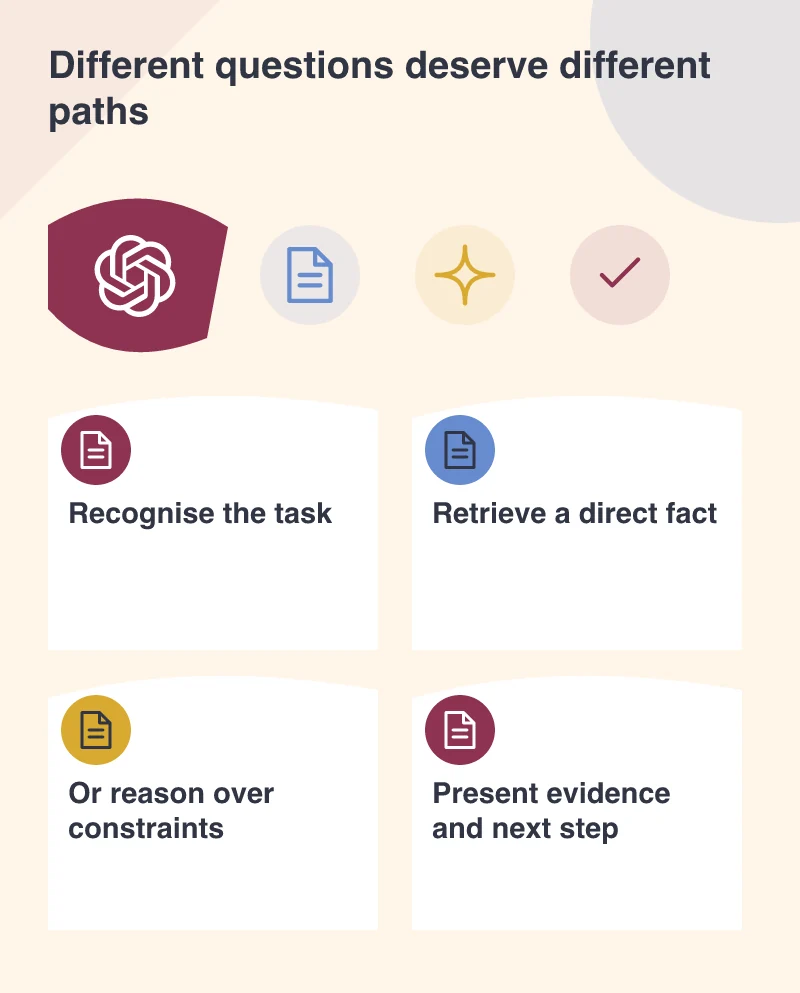
Start by separating direct lookups from judgement-heavy requests. An approved delivery policy can often be retrieved and shown. Choosing between several products with conflicting requirements needs a different process, with explicit assumptions and supporting evidence. Neither task benefits from being disguised as the other.
Design a useful wait
For a longer comparison, show what the system is doing in terms the customer understands. “Comparing the requirements you supplied” is meaningful when that is the actual work. A theatrical stream of invented reasoning is not necessary. Keep the input visible so the customer can correct it.
Imagine a buyer comparing three commercial ovens against space and power constraints. The useful output identifies the relevant specifications, explains mismatches and lists any missing measurements. It should not simply take longer to produce a more confident version of the same generic recommendation.
Evaluate the routes separately
A single average satisfaction score can hide two different problems. Quick questions may be unnecessarily slow, while difficult questions may be answered too eagerly. Review examples from both groups and judge them against the job they are meant to do.
Include a few requests that should be clarified before answering. If the oven’s installation space is unknown, asking for that measurement may be the best result. Good evaluation recognises an appropriate question as progress, rather than rewarding only complete-looking answers.
Offer a way to refine the request while preserving the evidence already collected. If the buyer adds a power-supply constraint, the application should show how that changes the comparison. A considered answer becomes more useful when the person can see which requirement drove the result.
Keep control of the surrounding experience
The model is one part of the service. Retrieval, business rules, interface states and human contact still shape whether the result is useful. Keep them visible in the design instead of expecting a model upgrade to resolve unclear product requirements.
This is an opportunity to make AI feel more considerate: quick when the answer is straightforward, patient when the problem deserves attention and clear about the evidence either way. The customer experiences that distinction as good service, without needing to understand the model selection behind it.