
At first glance, the picture is excellent. Look again and the important object is in the wrong place, a relationship is reversed or a detail contradicts the brief. Imagen’s May research puts language understanding and image-text alignment at the centre of text-to-image work. That is interesting for designers because the hardest part of approving an image is often deciding whether it communicates the intended meaning, not whether it looks polished. A business needs a review method that can notice the difference.
Break the brief into things a person can check
The Imagen paper, submitted on 23 May, studies the relationship between language understanding and image generation and introduces a challenging evaluation set. The research result is not a general promise that every production prompt will be followed correctly. Its practical relevance is the attention it gives to the connection between words and visible relationships.
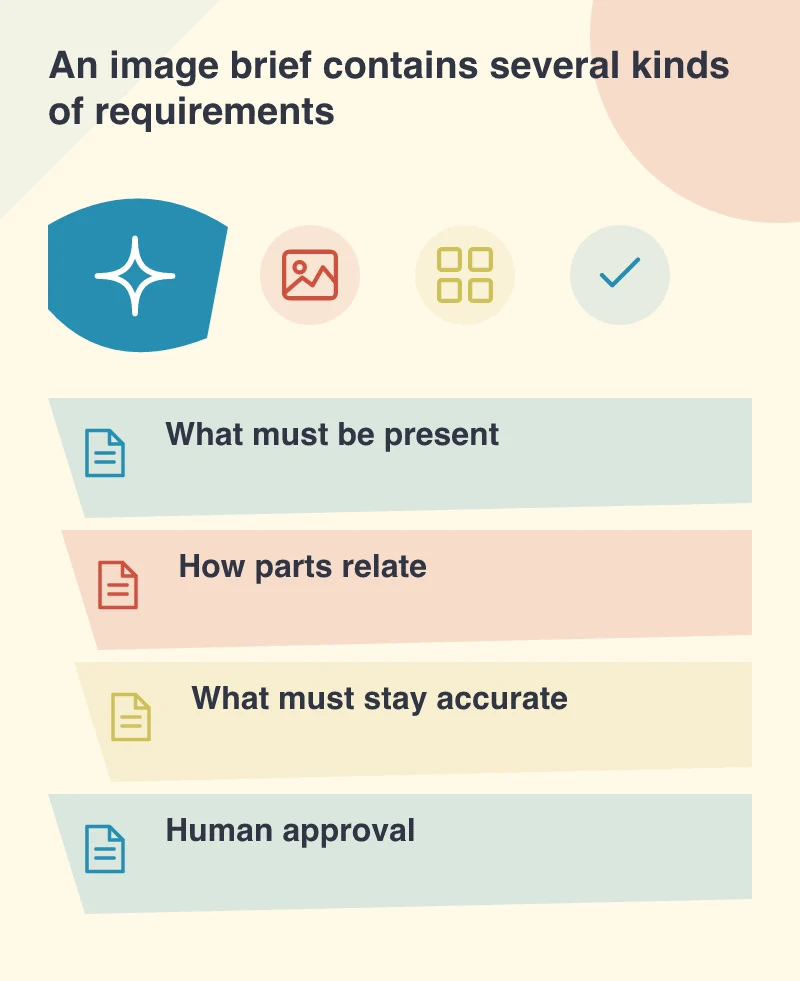
Write a brief with a few explicit requirements. Which object is central? What action is taking place? Which detail must remain factual? A reviewer can then inspect those requirements individually instead of relying on a broad feeling that the image looks professional.
Decide which mistakes change the message
Imagine an editorial illustration explaining a customer sending a document to a business. If the direction of the exchange is unclear, the image may undermine the article even though its colours and rendering are attractive. The mistake is semantic: the illustration is telling a different story.
For a real product image, the tolerance is narrower still. A changed fitting, extra control or inaccurate material can create a false expectation. A visually persuasive output should not receive a lighter accuracy review simply because it is more convincing.
Choose the production method around the job
Some briefs call for photographic evidence, others for a diagram and others for exploratory artwork. A clean drawing with a small number of checked labels can be a stronger explanation than a complex generated scene. The decision should follow what the audience needs to understand.
If generated exploration is useful, retain the part that serves the brief and correct or replace what does not. Keep a human owner for the final asset, including its crop, caption, placement and relationship to the surrounding text. Those decisions determine how the image will actually be read.
An image should answer the brief before its polish wins the discussion. Compare the named objects, their relationships and the intended audience, then decide what needs another pass. The point of visual exploration is a better communication decision, not simply the most impressive generated scene.