
The difficult part of a headless cart is not drawing a quantity control. It is making sure the quantity, price and availability shown in the interface agree with the store after every change. Magento 2.3.3’s tagged GraphQL schema, available since October, includes operations for cart items, coupons, addresses, shipping methods and order placement. As teams plan their next storefront, that provides a concrete basis for a trial rather than a general promise that APIs will handle everything.
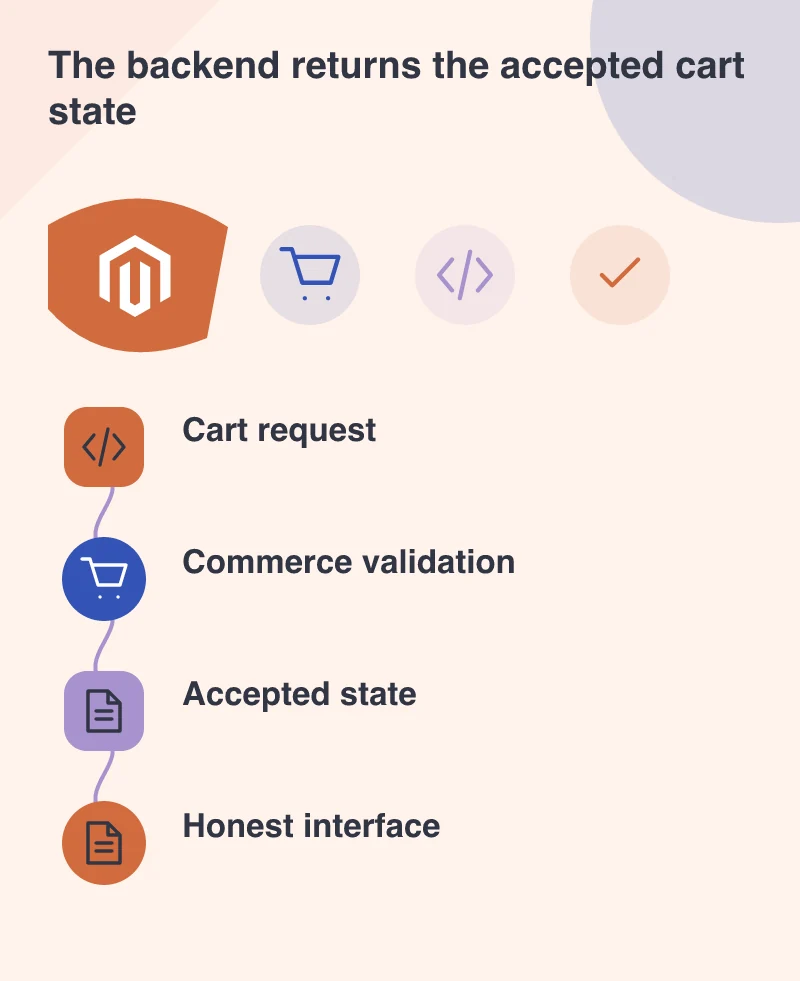
Let the store return the accepted state
Imagine a buyer adding three units and then changing the quantity to five. The interface can show that a request is in progress, but it should display the state the commerce service accepts. Stock rules, purchase limits or a changed price may affect the answer. Do not duplicate those rules in browser code and assume the two implementations will stay identical.
For each mutation, establish how the frontend receives the updated cart and how errors are represented. A successful network response and a successful business action are different things. The shopper needs to know whether the item was added, rejected or changed, with enough context to choose what to do next.
Treat a coupon as a complete interaction
The schema includes applying and removing a coupon. Trial both, including an expired or ineligible code through a safe test setup. Show which total changed and preserve the rest of the cart. A general error banner that leaves the old total on screen can make the buyer unsure whether to proceed.
Keep the calculation authoritative on the store. If a promotion has conditions, the frontend should explain the response rather than inventing a different discount to make the animation look responsive. The business also needs a maintainable way to change those conditions without commissioning matching edits in several interfaces.
Prove the actual product and payment combination
A schema lists capabilities, not compatibility with every extension. Review the precise product types, customer context and payment methods the planned store uses. Build a trial around a representative item, the required shipping route and the provider’s approved payment test facilities. A simple-product demonstration does not establish a complex custom product journey.
The same applies to authentication and cart ownership. Test a guest, a signed-in customer and an expired session. Keep trusted credentials out of public frontend code. The team should explain how access is authorised and how a shopper can recover without accidentally seeing or overwriting another person’s cart.
Make interruptions part of the design
Change the connection during a request and test a repeated click. The person should see a clear pending or failed state, not an order confirmation invented locally. Agree how retries are identified and how an uncertain outcome is checked against the server. This matters especially around final order placement.
A separate frontend can offer a tailored shopping experience, but it also owns the responsibility of explaining the commerce responses well. The December planning question is therefore specific: can this implementation demonstrate the full, awkward cart journey with the store’s actual rules? If it can, the architecture has earned more confidence than a fast product-grid prototype alone.