
A shopper does not ask whether a store’s frontend is modern. They want to find the item, understand the options and know whether it can be delivered. Magento announced the general availability of PWA Studio on 15 January, giving developers tools for a different storefront architecture. It is an opportunity to improve that journey. It is also a reason to be precise about which responsibilities remain with the commerce backend.
The storefront is not the whole store
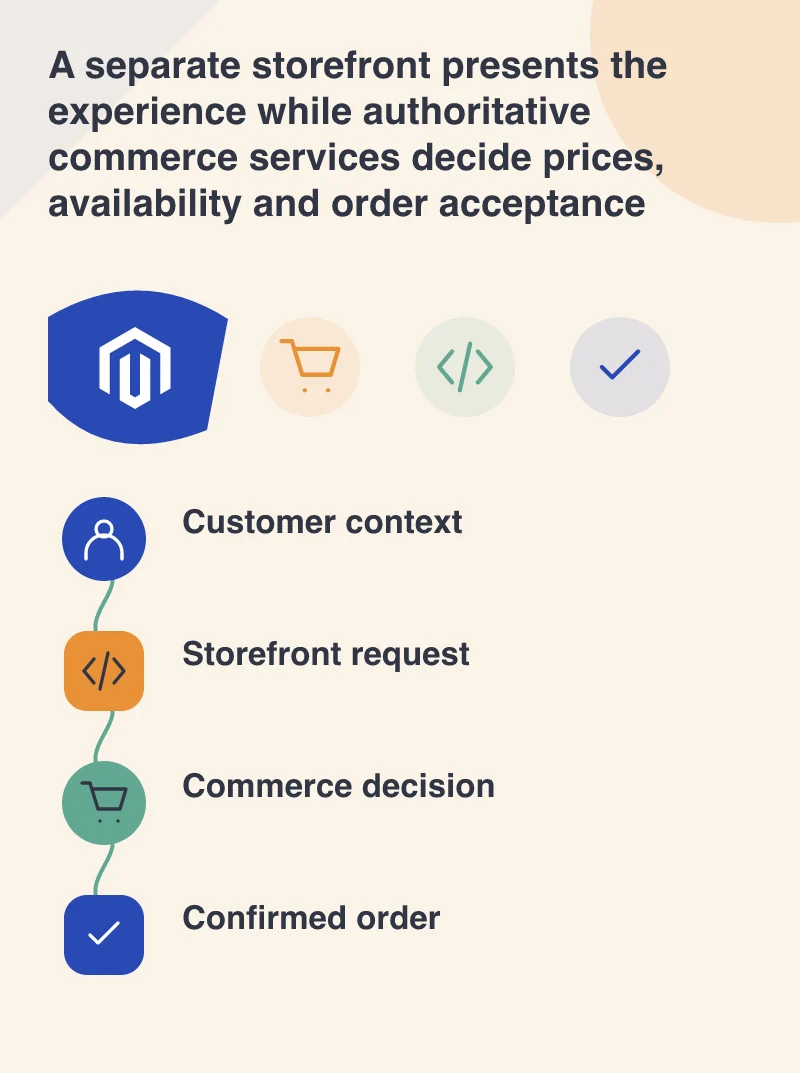
PWA Studio provides tools for building app-like web storefronts using a separate frontend approach. The interface can be developed around the shopper’s task while communicating with commerce services. Prices, stock rules, customer entitlements and order acceptance still need an authoritative source. A new interface should not invent a second, conflicting version of those rules.
Imagine a trade buyer who sees negotiated prices only after signing in. A polished product card must still show the right price for that customer, currency and store context. The architecture decision becomes real at that point: where is the context established, how is it sent and what prevents one buyer from seeing another buyer’s information?
Choose a journey that exposes the difficult parts
A home page prototype demonstrates visual direction but leaves many commerce questions unanswered. Trial a product with options, a cart change and a checkout handoff using approved test services. Include an unavailable combination. Observe whether the shopper receives a clear explanation without losing the choices they have already made.
Review existing extensions one by one. An extension designed to add markup to a traditional theme may not supply everything a separate frontend needs. The project estimate should identify API availability, custom interface work and ownership of failures between the two sides. The fact that an extension works on the present store is the start of that review, not its conclusion.
Offline browsing must not make live promises
A PWA can use caching to keep selected resources available and make repeat visits more resilient. That does not mean an order is accepted without a connection. Decide which catalogue details may be retained, how stale information is labelled and when a live confirmation is required. Stock and final totals deserve particular care.
The trade buyer might prepare a draft list with previously loaded information while disconnected. When the connection returns, the store can verify availability and pricing before asking them to proceed. Explain any differences. Silently changing the order or pretending it was submitted earlier would make the convenience harder to trust.
Judge the build by the complete purchase
Compare load and interaction behaviour using representative phones and a repeatable test, but also complete the transaction. Check search visibility, accessible controls, analytics requirements and support tools as part of the scope. A frontend can be quick to display yet still leave a customer unable to select an option or recover an abandoned cart.
PWA Studio is a toolkit, not a guaranteed conversion result. A sensible evaluation ends with a demonstrable journey and a list of the integrations still required. That gives the merchant something firmer than an architecture label: evidence that the proposed storefront can make shopping easier while preserving the store’s actual business rules.