
The person who built a website will not always be the person maintaining it. A handover consisting of one administrator password leaves the next maintainer guessing about extensions, hosting and backups. Joomla 3.9.11 was released on 13 August. Whether this month’s update is routine or part of a change of support, it is a sensible point to build a short, usable record of the installation.
Describe the installation that actually exists
Record the Joomla version, active template and the extensions that perform important tasks. Include their purpose, source and licence ownership where relevant. A list of package names alone is not enough. The next person needs to know that one component sends enquiries, another controls member access and another exists only for an old campaign.
Imagine taking over a small association website. The registration form may depend on a paid extension renewed by a former committee member. The site can continue working today while its next update or renewal is uncertain. Identify that ownership before the original contact disappears, and transfer it through the provider’s proper process.
Put the recovery route within reach
A useful backup includes what is needed to reconstruct the site, with an agreed location and access owner. Ask when a restoration was last demonstrated on a safe copy. A successful backup notification is not the same evidence as a working restoration. The maintainer should be able to explain the expected recovery route without relying on undocumented memory.
Add the hosting, domain and certificate contacts to the handover. Keep passwords and private keys in an appropriate secure system rather than a public project note. Separate the descriptive inventory from the secrets required to operate it. That makes the documentation easier to share with an authorised replacement without spreading credentials unnecessarily.
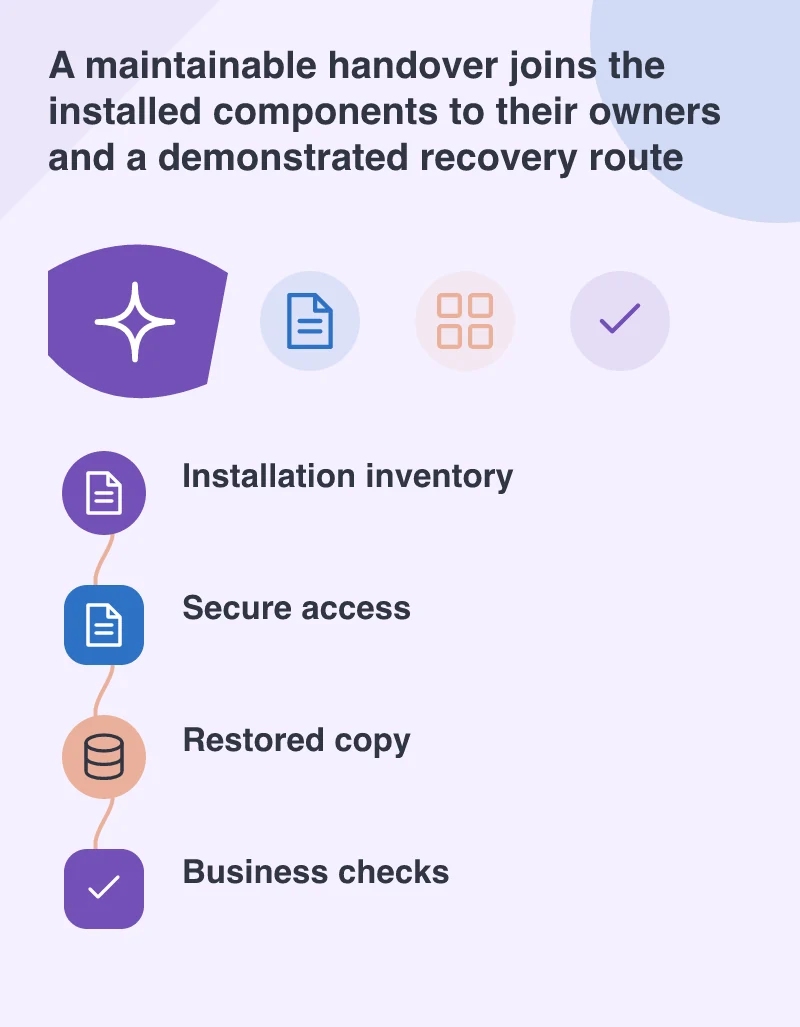
Save a few business checks
Write down the most important visitor tasks and their expected results. For the association, these may include reading event details, submitting a membership enquiry and signing into a member area. Use clearly marked test records and verify the receiving inbox or system. Include a normal editor’s publishing task too.
Run these checks before and after the update. They give the next maintainer a baseline that is more useful than a statement that everything was working when the original project ended. If a known limitation remains, record it honestly with the affected page and responsible contact. Concealing an awkward edge case does not make a handover more complete.
Keep the record short enough to maintain
A handful of accurate pages can be better than an elaborate document nobody updates. Give each item an owner and revise the inventory when an extension, integration or service changes. Link to the official release information used for maintenance so the next person can check the basis for the decision.
The August release provides a concrete maintenance event to record. The lasting benefit is continuity: someone authorised can understand the system, recover it and verify its essential work. That is the handover a business can depend on when staff, suppliers or committee roles change.