Building the same useful service for iPhone and Android can mean maintaining two implementations of similar screens. Flutter’s first beta, announced on 27 February at Mobile World Congress, offers another route: a portable toolkit for native mobile interfaces. That is an interesting development option, but a business evaluating it should test more than how quickly a developer can change a screen. Customers still arrive with expectations shaped by their own phones.
Choose a pilot that contains the difficult parts
The beta announcement describes a reactive framework, a rich widget set, integrated tooling and stateful hot reload for faster iteration. It targets iOS and Android, but the release is still a beta. A business should evaluate the maturity of the specific integrations it needs rather than read the launch as a universal production guarantee or a reason to replace every existing native application immediately.
An appointment service considering Flutter might pilot browsing dates, signing in and confirming a booking. Include a task that uses a device capability if that is central to the product. A polished static list tells little about the work required for a camera, a payment integration or a complex notification flow. The pilot should answer the real feasibility question, not simply reproduce the easiest screens in the brief.
Shared design does not mean identical habits
People expect navigation, text entry and system interactions to feel understandable on the device they use. Test back navigation, keyboard behaviour, permission prompts and interruptions on both platforms. A shared visual system can still respect those differences. The product team should decide which parts of the experience express the brand and which should follow familiar platform behaviour, instead of leaving the distinction to accidental defaults.
Hot reload is useful during that discussion because a designer and developer can try a change without repeatedly restarting the whole app. It does not remove the need to check the saved state after a real restart or a release build. Fast iteration and reliable delivery are related but separate achievements. Keep notes on what the pilot proves and what is still only convenient inside the development session.
Count the work around the screens
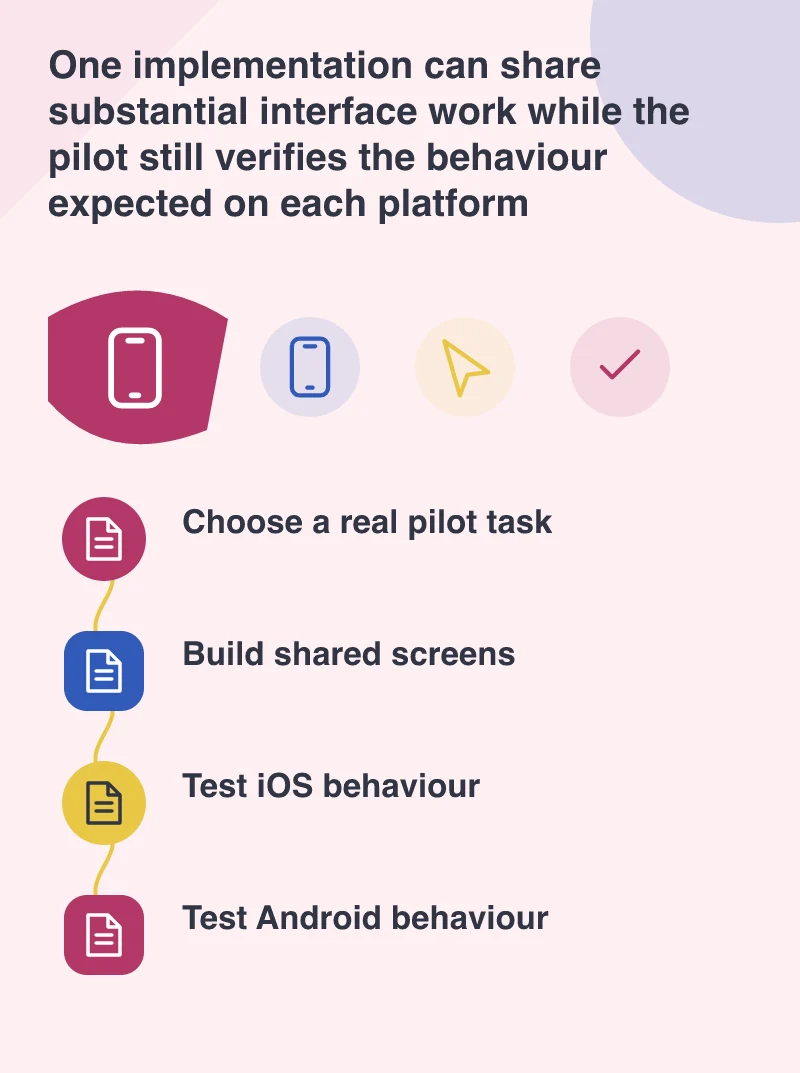
A codebase also needs testing, build configuration, store distribution, monitoring and ongoing maintenance. List the plugins or native integrations required by the project and establish who will maintain them. A dependency that supports the demonstration but lacks a clear update path may create work later. The evaluation should include these responsibilities alongside the number of screens that can be shared.
Compare the approaches through a working task on both iOS and Android. Record the strengths, the unsupported requirements and the effort of the platform-specific pieces. Flutter’s beta makes a new development approach available to explore. The decision to use it should follow the service being built, the team who will run it and the experience expected by the people opening it.