A merchandising assistant needs to refresh a changed product page. Giving that person unrestricted control over the whole shop may be the quickest way to solve the immediate access problem, but it creates a much larger responsibility. Magento’s 27 February security release introduces finer permissions for common cache-management tasks in version 2.2.3. That small operational feature is worth a larger conversation about how administrator roles match the work of a store.
Separate a business task from a powerful account
The official Magento announcement lists security changes across several versions, USPS API support and more granular cache permissions for 2.2.3. A merchant should check the release and patch route appropriate to its installed edition rather than assuming every listed package applies. The permission change does, however, provide a concrete reason to review a role that was granted broad access simply to unblock a routine action.
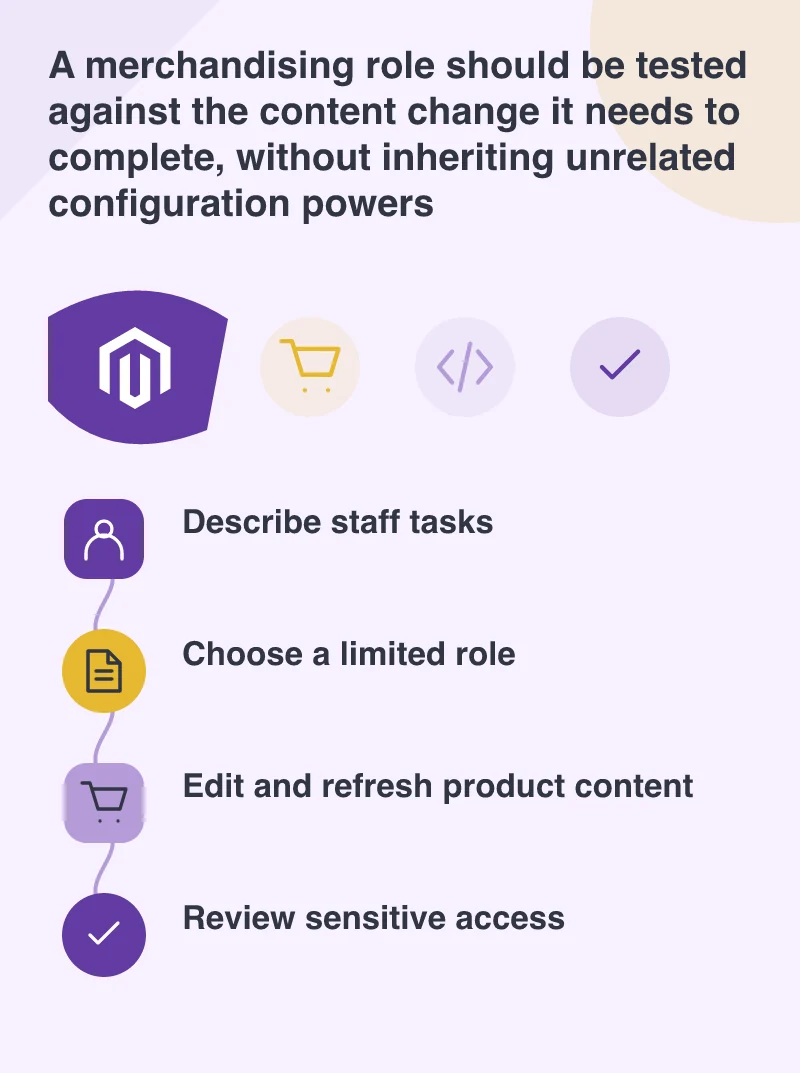
Imagine a homeware retailer assigning catalogue editing, order fulfilment and payment configuration to different staff. Start with a list of what each person needs to accomplish. Then map those tasks to the available controls and test them using the intended role. A full administrator account can make a workflow appear successful while concealing the fact that ordinary staff cannot complete it or have been given more power than necessary.
Make cache behaviour less mysterious
A cache stores reusable results so the shop need not repeat every piece of work for every request. That can mean a recently edited page does not appear exactly when an editor expects. The answer should be an understandable publishing routine, not a superstition that every problem is solved by flushing everything. Explain which normal action refreshes the relevant content and when somebody should ask for help.
Try an actual product change with the merchandising role: update a description, confirm the saved value and view the public page. If an authorised cache action is necessary, check that the person can perform the required task without accessing unrelated configuration. Also confirm that the page still behaves correctly for another visitor. The test should cover the whole editing outcome, not merely whether a new permission checkbox can be selected.
Keep accountability when the team changes
Use individual accounts and review access when people change responsibilities or leave the business. A shared “shop admin” login makes it harder to know who made a change and easier to leave unnecessary access in circulation. Document who owns the high-privilege account, who handles extension updates and who can respond if an ordinary role is blocked during a busy trading day.
February’s security release also needs the normal careful update process: a recoverable copy, checks of extensions and verification of the store’s important journeys. Role design can be reviewed alongside that work without turning the release into a complete reorganisation. The useful result is a staff member who can publish the intended change confidently, and a store whose more sensitive controls remain with the people responsible for them.