

A store upgrade can look like a feature decision until the team discovers that search, payments or administration depends on an older part of the stack. Magento 2.4 arrives in July with changes that make the underlying environment especially important. For a merchant, the sensible question is not simply what the release adds. It is whether the complete system can be upgraded and operated coherently.
Read the requirements before the feature list
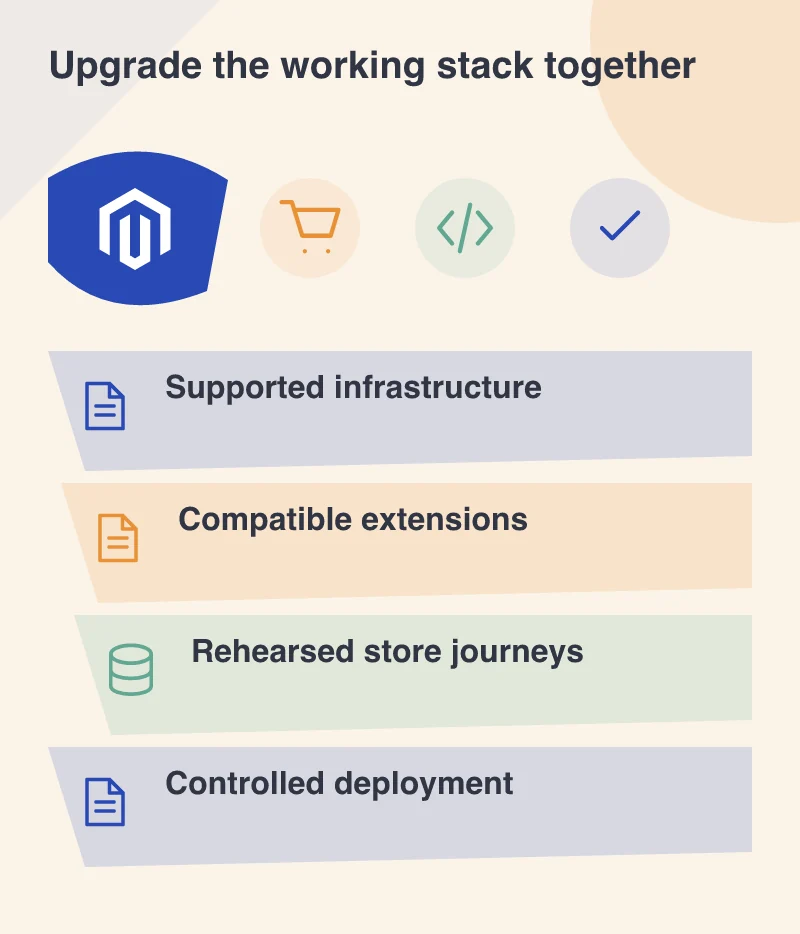
The version-specific 2.4.0 notes introduce support for PHP 7.4, Elasticsearch 7.6.x and MySQL 8.0, and describe two-factor authentication being enabled for the Admin by default. These are concrete planning items. A host, developer and store operator need a shared understanding of the environment and the way authorised staff will access it.
A store should not assume that an existing search configuration or integration remains suitable because the public design is unchanged. Start with the supported stack and the installed extensions, then decide what must be replaced, configured or tested as part of the upgrade.
Search is an operational feature
Consider a parts retailer. Customers may search by a model number, an abbreviated name or a product attribute. A search page that returns something is not necessarily returning the useful thing. Keep a set of representative queries and compare the results on the test environment before the release is accepted.
Include the catalogue team in that review. They can recognise whether a missing result is caused by incomplete product information, an indexing problem or a search configuration that no longer matches the catalogue. This avoids asking infrastructure changes to solve what is actually a data problem.
Prepare the people who administer the shop
Two-factor authentication affects the working day of the people processing orders and maintaining content. Arrange enrolment and recovery procedures before a busy trading period. Each person should use their own authorised account, with access appropriate to their role. Shared credentials make it harder to understand who changed something and harder to recover cleanly from an access problem.
The test should include signing in after the relevant configuration has been applied, not merely checking that an account exists. Make sure the business knows who can assist if a staff member loses access to their second factor.
Rehearse the whole order route
Use a protected copy to test catalogue browsing, search, price rules, basket updates, payment and order handling. Include at least one ordinary order and one exception such as a cancellation or an unavailable item. Keep external services in their supported test modes so that a rehearsal does not become real customer activity.
The release provides a useful boundary for removing assumptions. Record the supported versions, extension decisions and test results together. A dependable Magento upgrade is not established by a new version number in the dashboard; it is established by a store that the team can run and customers can use after all its connected parts have changed.