

The payment page returns a customer to the store, but the order is still marked as pending. That can be an expected intermediate state or a genuine integration failure. A maintenance review needs to know which. Magento’s February 2.4.6-p4 release is a practical reason to revisit the payment checks in a store’s patch process, without assuming that a patch notice describes the behaviour of every installed payment extension.
Inventory the payment paths before testing
List the payment methods actually offered to customers and the different routes they take. Some methods keep more of the interaction inside the checkout; others redirect to another service and return later. Record the extension and provider configuration used for each route, rather than treating all payment buttons as one test case.
Read the applicable release information and supplier compatibility guidance for the versions involved. The existence of a platform patch establishes a maintenance milestone. It does not, on its own, prove that a custom extension has been reviewed or that every payment scenario behaves identically after the change.
Use an isolated and recognisable test
Rehearse the update on a suitable separate environment with supported test credentials and test payment methods. Prevent that environment from creating real fulfilment instructions or contacting actual customers. Everyone taking part should know which systems are connected and how the test orders will be identified.
Check a successful payment, a cancellation and a declined or interrupted attempt where the provider supports those test conditions. Inspect the customer’s screen and the resulting order record. The screen should not promise a confirmed order before the relevant system state has been established.
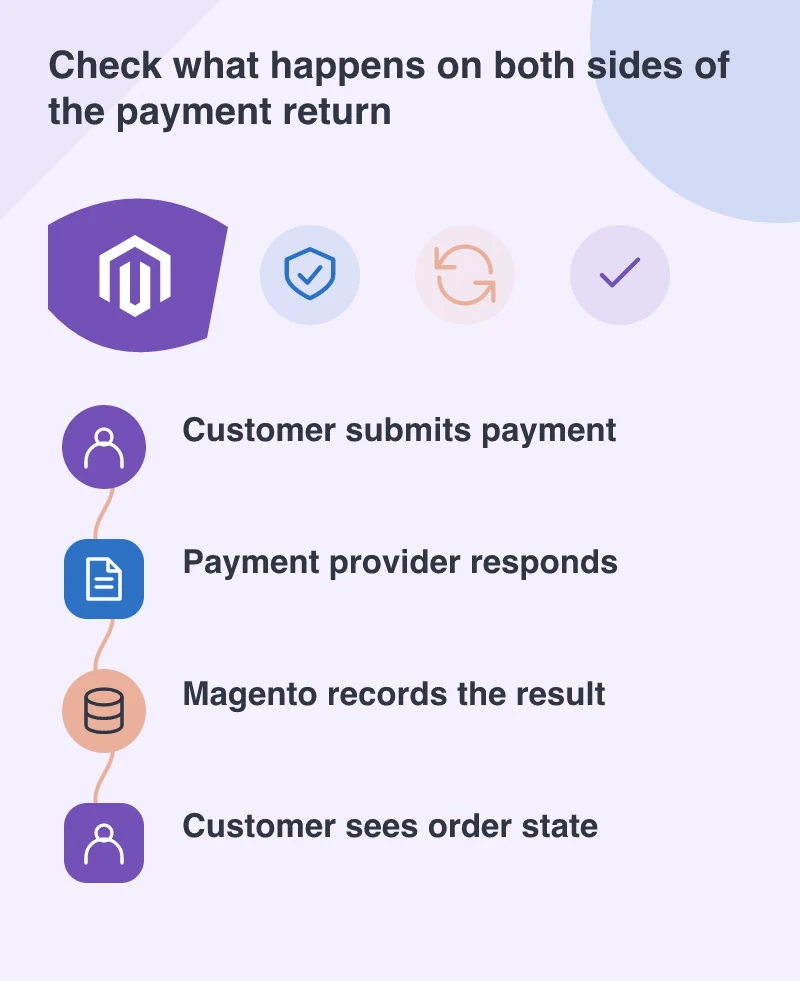
Follow delayed responses and repeated requests
A customer may close a tab, lose connectivity or press the button again because nothing seems to happen. The integration needs an understandable response to those conditions. Repeated browser actions should not silently create duplicate orders or leave the customer unsure whether they have paid.
Compare the browser return with the server-side confirmation route used by the integration. They can arrive at different times, so the storefront should handle a pending state honestly. Give staff a way to investigate the record and its relevant provider reference without asking the customer to guess what happened from a screenshot.
Make the result part of the maintenance record
Save the payment methods tested, the expected states and the evidence of the resulting orders. Note any path that could not be tested and who owns the next check. A release approval is more useful when its limits are visible rather than concealed behind a general statement that checkout works.
After deployment, observe the ordinary order flow and support reports for the agreed period. Testing reduces uncertainty but does not replace operation. A well-maintained checkout explains its successful, delayed and unsuccessful paths clearly, so a customer receives an accurate explanation even when payment does not follow the simplest route.