
A mobile application often outlives the first team that built it. New developers inherit the screens, libraries and assumptions, then need to change an ordinary feature without disturbing unrelated work. A clear boundary between supported platform behaviour and application-specific decisions makes that handover easier.
Prefer the supported entrance
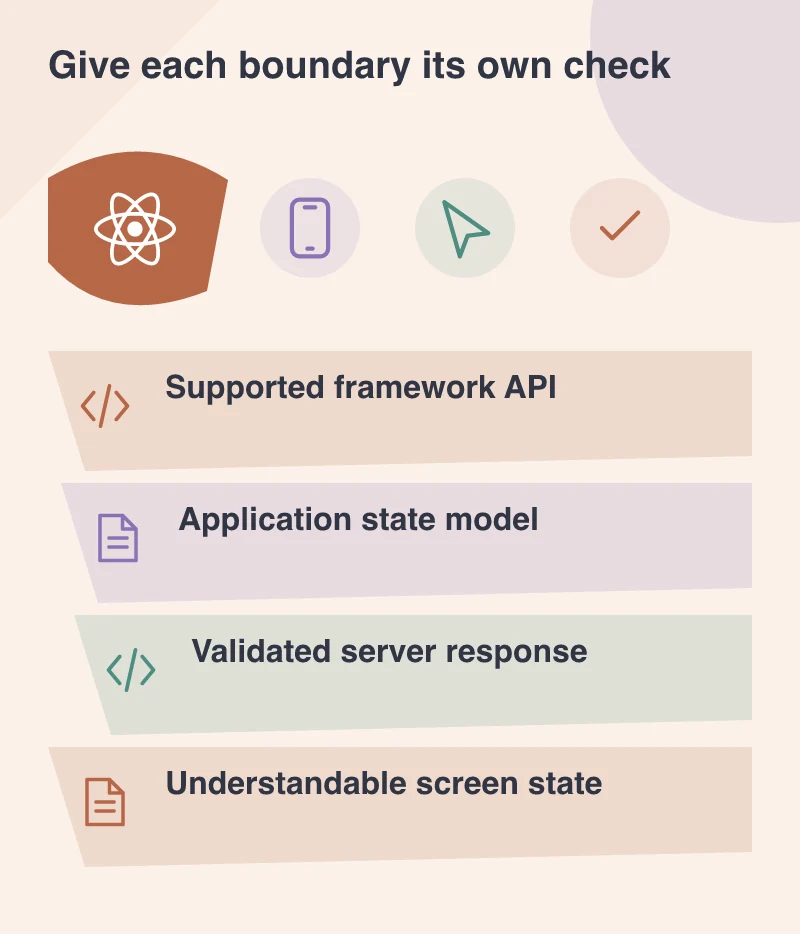
React Native 0.87 makes its Strict TypeScript API the default, with types generated from source and the public surface centred on root exports. The August release gives teams a concrete reason to review dependencies on internal framework files. An internal shortcut can become a maintenance cost when the platform changes.
For a business owner, the question is straightforward: can the app be updated through documented interfaces, or does it depend on implementation details that nobody owns? This does not decide whether the app is good, but it helps explain part of its maintenance risk.
Use types to describe real states
Framework types are one layer. The application’s own model should also represent the states people encounter. A booking can be a draft, a submitted request or a confirmed appointment. Treating all three as an object with several optional fields can leave too much ambiguity in the interface.
Imagine an app showing a confirmation screen before the server has accepted a booking. A clearer state model can help developers keep “sending”, “accepted” and “failed” distinct. The customer then receives feedback that matches what the system actually knows.
These distinctions also make design discussions easier. A developer and designer can agree on the screen for each state instead of discovering a missing case after the interface has already been built.
Keep runtime validation separate
TypeScript helps during development; it does not prove that an incoming network response contains valid business data. Check the information crossing the server boundary and handle unexpected values deliberately. A well-typed screen still needs a sensible response when a record is incomplete.
Do not solve a data problem by silently inventing a default that changes its meaning. If an appointment time is missing, the app should not display an arbitrary time just to satisfy the layout. Show an understandable unavailable state and a relevant recovery path.
Make the maintenance story inspectable
Ask for a short map of the app’s important dependencies, public interfaces and business states. Keep it close to the code and update it when decisions change. This is more useful than a broad claim that the app uses a modern stack.
A stricter framework boundary can support a more maintainable application. Its value grows when the team applies the same clarity to its own data and screens. Future changes become easier to reason about because the app says what it knows, what it expects and where each responsibility belongs.