
A report says that a page is not indexed, and the business wants to know why. The answer is rarely improved by treating every excluded URL as a fault. January’s changes to Google Search Console’s Index Coverage reporting make some statuses more precise. That is useful because a clearer status can support a narrower investigation, provided the team first understands what the page is supposed to do.
A status is evidence, not an instruction
Google’s January announcement describes refinements to coverage reporting, including more specific treatment of some crawl and indexing situations. The value is diagnostic. The report does not decide whether every address on a website should appear in search or whether an intentionally excluded URL needs to be opened to crawling.
An online store can produce many addresses for filters, internal search, account functions and ordinary product pages. Those addresses do not all serve the same public purpose. Understanding that purpose is the first step towards interpreting the report.
Start with one representative URL
Imagine a retailer seeing a group of URLs with the same reported problem. Open one and identify the template, the visible information and the intended search role. Is it a genuine product page, a removed item, an empty filter combination or a utility page? Those cases should not receive the same correction.
Check the response and relevant directives, then compare another URL from the group. A pattern affecting a shared template is different from an isolated content mistake. Grouping by cause can turn a large-looking report into a manageable set of decisions.
Avoid solving a reporting symptom with a broad rule
Removing a robots restriction or changing a noindex instruction may make one status disappear while creating another problem. Before changing either, establish why the rule exists and which pages it applies to. A development team should be able to explain the intended relationship between crawl access, indexing eligibility and the content available at the URL.
For pages that should remain discoverable, inspect whether the public page provides the expected information and whether important internal links reach it. A sitemap entry alone does not replace a useful page or a coherent route through the site.
Keep the investigation understandable
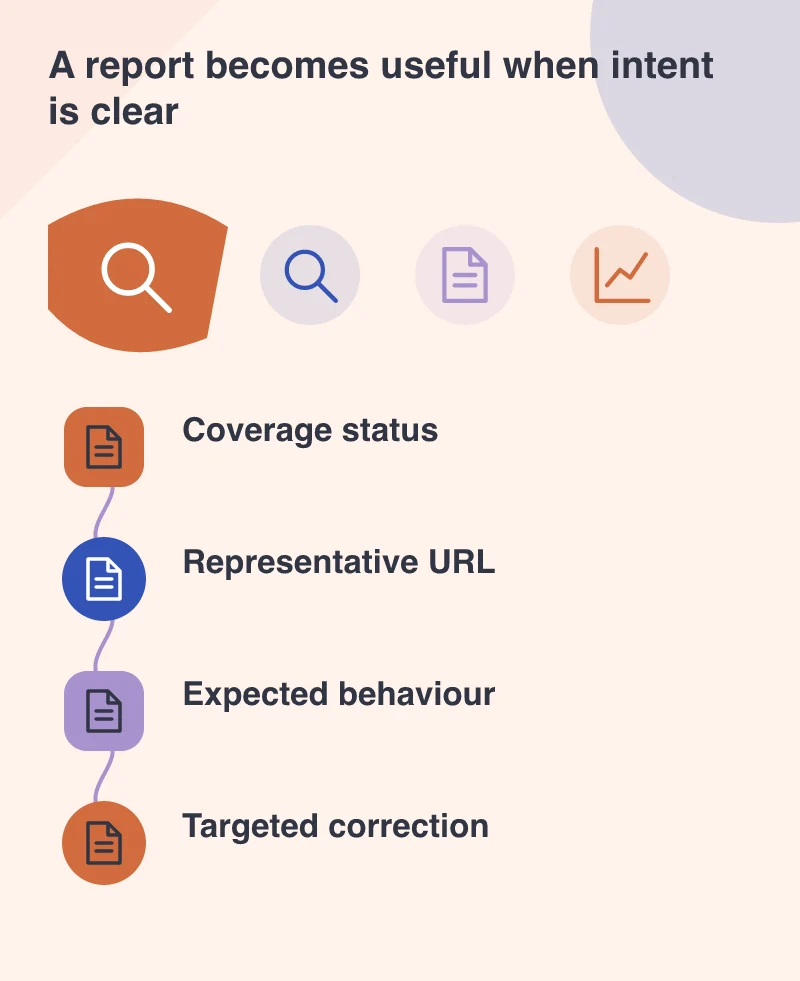
Record the reported state, the representative URL, the intended behaviour and the change made. If no change is needed, record that decision too. This prevents the next report review from restarting the same discussion as if every exclusion were a newly discovered emergency.
A coverage review is most productive when it starts with the intended role of the URLs. Which customer information should be findable, and which technical obstacle is preventing it? Some excluded URLs are expected. Trying to force every category to zero can distract the team from the pages that need attention.