

“Find a lamp that fits this desk” is a different opening to a shopping journey from typing a product name into a store. The assistant needs dimensions, availability and a way to continue the purchase. Shopify and Google have announced the Universal Commerce Protocol, an open standard for agents to interact with commerce systems. For a merchant, January’s announcement makes the quality of the underlying catalogue particularly interesting.
Make the product answer a real question
Choose a product that customers need help evaluating. A desk lamp might need its height, base dimensions, light characteristics and compatible accessories explained clearly. Identify which facts are available as useful product data and which exist only inside a photograph or a description somebody has to interpret.
The first improvement can be small. Put the decisive measurement in the right place, agree its unit and check it against the product the warehouse actually sends. Better information helps a person on the website as well as an assistant preparing a comparison. It is useful work even before a new shopping channel is enabled.
Carry the buying context with the item
A recommendation needs the offer that applies to the shopper. Availability, destination, selected variation and relevant purchasing conditions all affect whether the item is a sensible choice. Ask how that context reaches a proposed shopping experience and how it is checked again when the buyer proceeds.
Shopify’s engineering explanation describes UCP as a flexible way to represent commerce capabilities. The practical design still has to make the selected item and offer understandable. A customer should be able to recognise the same product when moving from a conversation into the next stage of buying.
Give the buyer an understandable handover
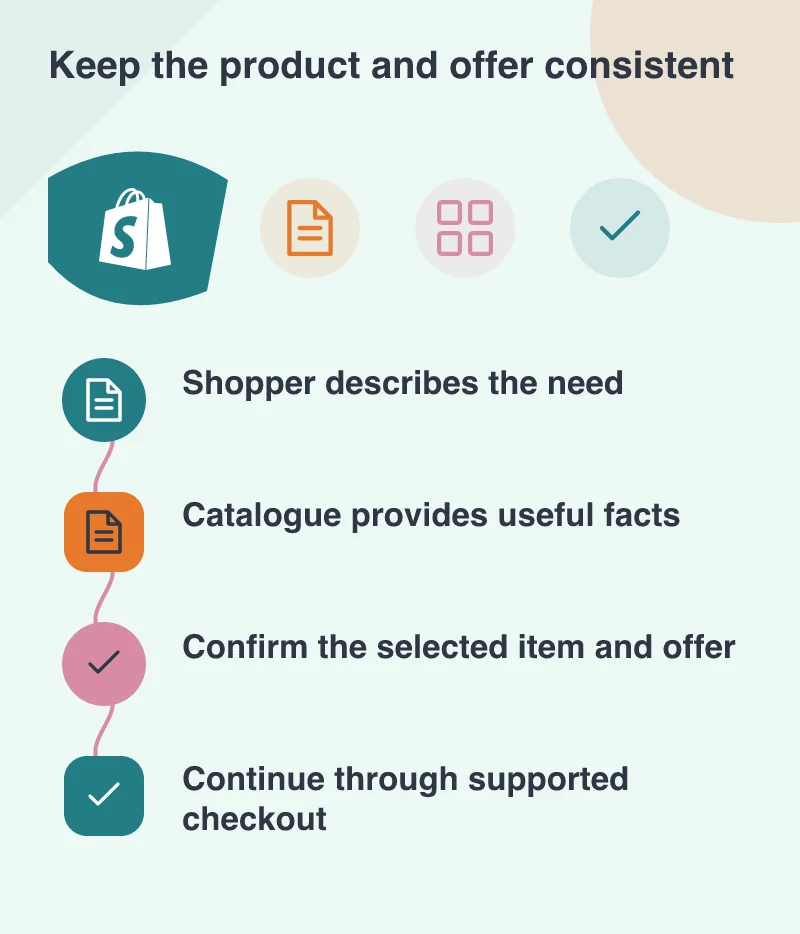
Write the journey in ordinary language: compare suitable lamps, inspect the chosen one, confirm the offer and proceed through the supported purchase steps. Decide where the buyer reviews the details and what they are being asked to approve. A smooth conversation is more reassuring when those moments remain clear.
Include the ordinary failure cases in the brief. An item can sell out, a delivery address can change the offer and an assistant can misunderstand a requirement. The experience needs a useful correction or return path, with the buyer’s choices retained where appropriate. Test those situations before treating the ideal demonstration as a finished service.
Build a small, observable first experience
January’s announcement describes a developing commerce ecosystem, so confirm the surfaces and capabilities actually available for the proposed store and audience. Start with a bounded catalogue and a supported route to purchase. A clear scope lets the team investigate questions without promising that every assistant will handle every transaction.
Follow the resulting order into fulfilment and support. The business still needs to identify what was ordered, understand where the shopper came from and resolve a question after the conversation ends. A well-prepared catalogue and a dependable handover give the new interface something solid to work with.