
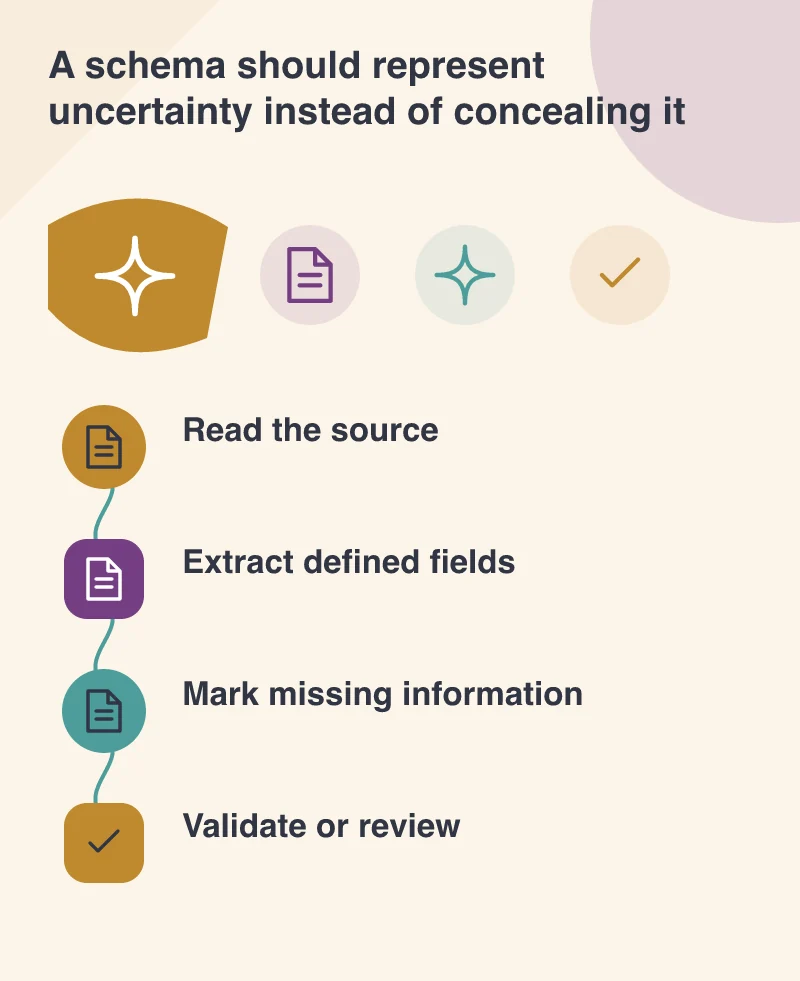
An incoming document does not state a delivery date. The destination system requires a delivery-date field. If an AI workflow fills the gap with a plausible guess, the record may look complete while the business promise is false. OpenAI’s August Structured Outputs announcement improves control over response shape, making this a good time to design how the schema represents information that is absent or uncertain.
Give missing information a legitimate state
Begin with the record the business actually needs. Identify which fields are essential, which can be empty and which require human interpretation. A schema that leaves no honest way to express an unknown value can encourage the surrounding workflow to treat an incomplete source as a completed record.
For a supplier enquiry, the product reference may be present while quantity or timing remains unclear. Keep those differences visible. The application can request clarification or create a review task instead of inventing a default that a colleague later mistakes for the customer’s instruction.
Distinguish schema conformity from factual correctness
Structured Outputs can constrain a supported response to the developer’s supplied schema in the announced modes. That is stronger than merely asking for valid JSON. It still does not prove that a product reference was read correctly or that the source document belongs to the signed-in account.
Validate the meaning after parsing: confirm referenced records, check applicable ranges and enforce permissions in the business application. The model’s output should not become the authority for a rule simply because its field names and types are now more predictable.
Handle responses outside the happy path
The announcement describes refusal handling and the possibility of an interrupted response. Include those states in the application design. A downstream import should not assume that every request ends with a complete record ready to save. The interface needs to explain when extraction did not finish and what the user can do next.
Retries also need a deliberate policy. Distinguish trying to obtain a valid draft from repeating an action that has already changed a system. Keep record creation or external communication behind its own validated step so an extraction failure does not accidentally become duplicated business work.
Review examples that look almost correct
Test documents with similar identifiers, conflicting dates, unusual formatting and missing sections. Show the reviewer the source beside the proposed fields. Ask which errors would be difficult for a busy colleague to notice, rather than judging the output only by whether it passes the schema.
Structured Outputs can remove a frustrating class of formatting failures and make integrations easier to reason about. The stronger workflow uses that predictability to expose uncertainty, not hide it. A useful structured record says what is known, what remains unresolved and which checks were performed before anyone relies on it.