

A contact strip appears on twelve pages. Someone corrects the telephone number on one page and assumes the job is done. Elsewhere, the old number remains. WordPress 6.3’s August pattern improvements bring this everyday content problem into focus: before reusing a section, decide whether its copies should stay connected or become independent pieces of content.
Reuse has two different meanings
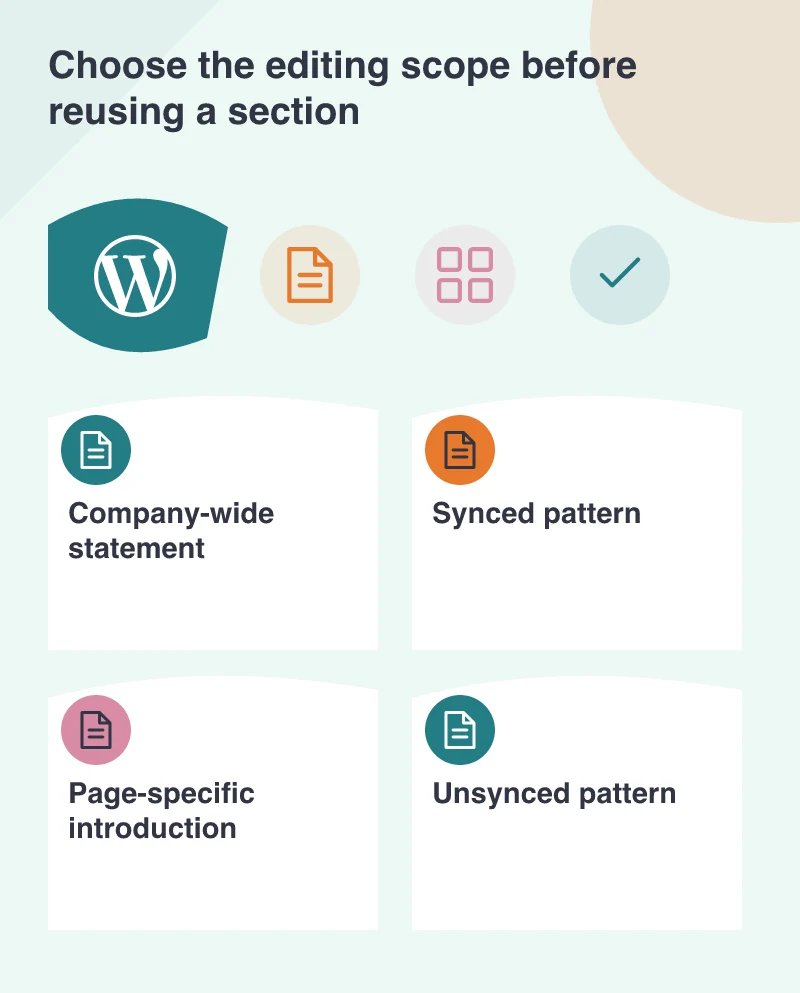
The release makes it possible to create and manage patterns within the editing workflow, including synced and unsynced patterns. A synced pattern is useful when the same message should remain consistent wherever it appears. An unsynced pattern gives an editor a starting arrangement that can then be adapted to a particular page.
The distinction is editorial as much as technical. A company-wide notice, a standard contact strip or a repeated legal statement may need one controlled source. A service introduction with a shared visual arrangement may need different wording on every page. Treating both cases as identical creates either stale copies or surprising global changes.
Name patterns for the job they do
A title such as three-column block tells an editor about the arrangement but little about its purpose. A clearer name might identify the company contact details or the service benefits section. The name should help someone choose the right starting point without opening several similar candidates.
Use a small collection of useful patterns rather than saving every variation. Duplicate patterns with nearly identical names create uncertainty about which one is current. Give someone responsibility for reviewing that collection, removing obsolete options carefully and explaining any pattern whose editing scope is easy to misunderstand.
Rehearse a change from the editor’s point of view
On a separate test page, change a shared contact detail and inspect the other places using that pattern. Then create a page from an unsynced pattern and change its local wording. The exercise helps the team recognise the difference in a real workflow rather than remembering an abstract definition.
Include permission levels in the review. A colleague responsible for article text may not be the person who should change a site-wide statement. Where the chosen workflow allows a broad change, make the preview and review process clear. The point of reusable content is to make deliberate updates easier, not to make their scope invisible.
Keep consistency where it helps the reader
A reusable layout should not force every service to tell the same story. Magento development, a WordPress publishing workflow and an AI integration need different explanations, even when their pages share typography and spacing. Consistent design can make those differences easier to compare.
A maintainable pattern needs a clear editing contract: which details are shared, which are local and who owns each one. Once that is settled, patterns can reduce repetitive work while giving editors room to say something specific. A site feels easier to maintain when a simple correction reaches exactly the places the editor expects.