

A website can collect a person’s details in several places without its owner seeing the whole picture. A contact form, a comment, an account and a separate mailing service may all hold different records. WordPress 4.9.6, released on 17 May, adds privacy-related tools, including facilities for personal-data export and erasure requests. They give administrators useful machinery. They do not decide which records a particular business holds or replace the decisions behind its privacy practices.
Trace one piece of information
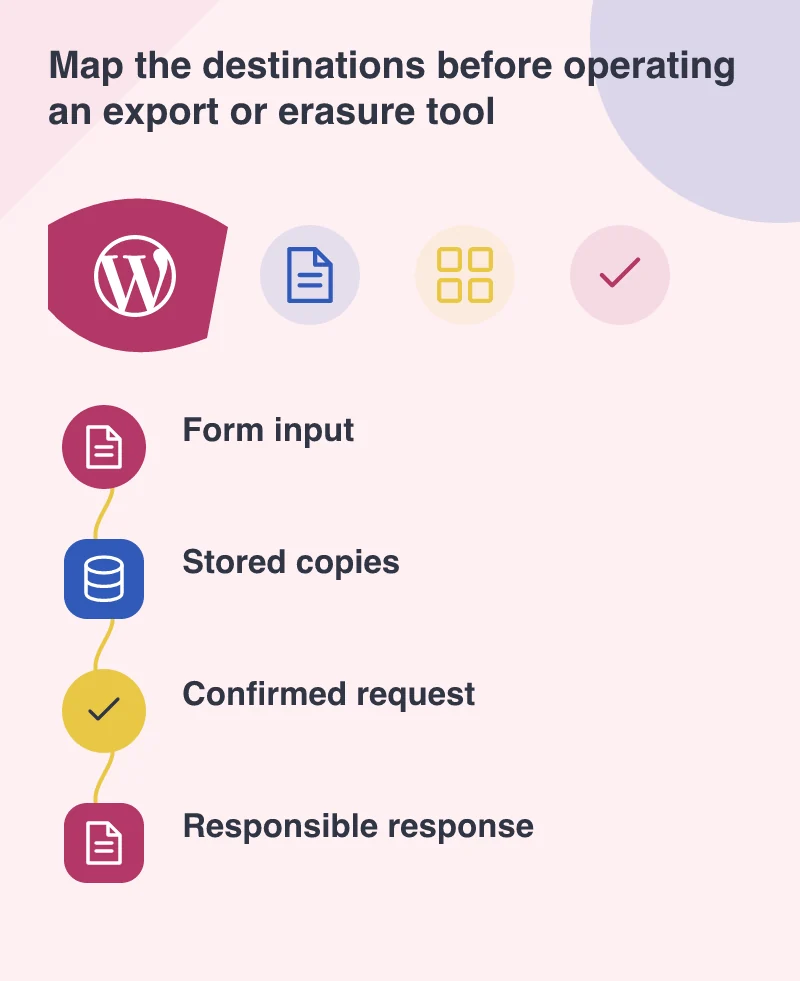
Take an enquiry form that asks for a name, email address and project description. Does it save a copy in WordPress, send one to an inbox and pass another to a customer-management service? Those are separate destinations. Draw the route before changing the form. Include backups and any exported spreadsheets used by staff, because the visible website may be only the first stop.
For each destination, record why the information is collected, who can access it and who administers that system. If a field has no clear purpose, question whether the form needs it. This exercise often makes the form easier to complete as well as making the site’s data handling easier to explain. The answer should come from the actual workflow, not a generic policy copied from another business.
Understand what the new tools can reach
The release introduces an email-confirmation process for export and erasure requests. Core tools can work with participating plugins, but an administrator should check the extensions installed on that particular site. A successful export screen does not prove that an unrelated CRM or a custom database has been included. Test the complete route with a clearly identified test record.
An erasure request also requires a responsible decision. Some records may need different treatment according to the business’s obligations and circumstances. Have the appropriate person decide the policy and obtain suitable advice where needed; do not make a developer guess. The website’s role is to support that documented process and show accurately which operations it has performed.
Turn policy text into operating instructions
WordPress 4.9.6 provides assistance for building a privacy-policy page. Treat suggested text as a starting point to review against the data map. A statement saying that information is never shared would be misleading if enquiries are routinely forwarded to an external service. Clear, specific language is more useful than a long list of technical terms that nobody maintaining the site can verify.
Assign an inbox and an owner for requests. Decide how a request is verified, how work in connected services is coordinated and how completion is recorded. Keep access to downloaded exports controlled; exporting personal information creates another copy that needs handling. Test the process from the requester’s perspective, including the confirmation message and an understandable response.
Maintain the map as the site changes
Adding a booking plugin or a new newsletter integration can change the data route even when the front page looks identical. Make a short privacy review part of approving those changes. Ask what is stored, where it is sent and whether the site’s explanation still matches reality.
The new release makes important administrative tasks more accessible. Its value depends on accurate configuration and people who know what to do with a request. A smaller form, a truthful explanation and a tested process are tangible outcomes a visitor can understand. Installing the update alone is not a declaration that the entire business has met every applicable requirement.