

The words in a privacy prompt are often written near the end of an app project. By then, advertising and analytics libraries may already be making decisions that nobody on the product team has clearly described. Apple’s April AppTrackingTransparency requirements bring that hidden work into view. Before asking how to make the prompt more convincing, ask whether the team can explain the data use itself.
Start with the library, not the sentence
Apple’s 20 April notice says that the relevant requirements apply from 26 April with the release of iOS 14.5 and related platforms. Apps seeking to track users or access the advertising identifier must request permission through AppTrackingTransparency. The notice also rejects fingerprinting as a workaround. It is a platform requirement to understand, rather than a wording exercise to optimise around.
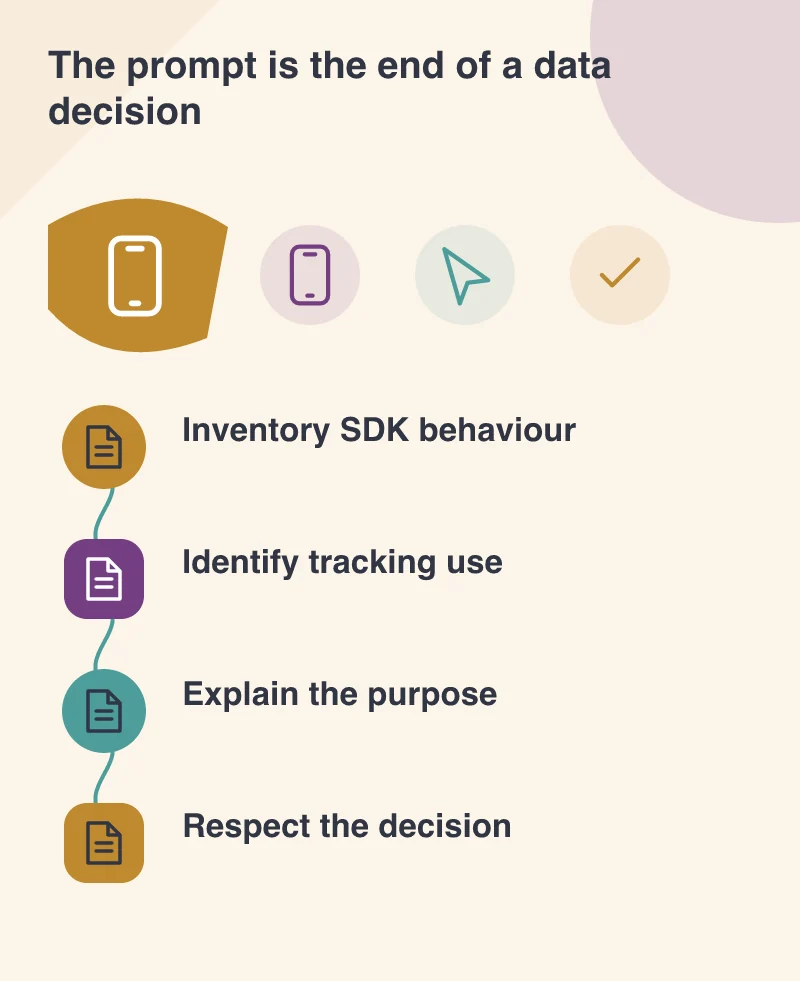
Make an inventory of SDKs and the reasons they are present. A crash-reporting service, an attribution library and a customer-support component may handle different information for different purposes. Ask each supplier for its relevant implementation guidance and compare that guidance with what the application actually enables.
Let the explanation follow the product decision
Picture a retailer’s app that includes an advertising SDK installed during an early growth experiment. If the team no longer uses that feature, removing the dependency may be a better decision than spending weeks explaining it to customers. If the feature remains, its purpose should be specific enough that the business can defend the request in ordinary language.
Avoid inventing a customer benefit merely because the prompt has room for one. The person deciding should receive an account of the actual purpose. Copy that says one thing while configuration does another creates a problem that a more polished interface cannot repair.
Test both answers
Permission handling needs a complete route when the person declines. Check the product’s essential functions, account screens and purchase journey with each relevant choice. The implementation should follow the decision rather than quietly substituting another tracking technique or repeatedly asking the same question without new context.
Also review how the state is communicated to external services. A permission screen and an SDK configuration are separate parts of the system. Testing only the visible prompt leaves the most important question unanswered: did the data behaviour change as intended?
Keep the record useful after release
Write down the SDK owner, enabled purpose, relevant settings and review date. Give the support team a short explanation that matches the interface. When another library is proposed, ask the same questions before it enters the application rather than relying on a growing stack of inherited assumptions.
For an app business in April 2021, this work can feel like a deadline-driven interruption. It is also a chance to understand the product more clearly. A truthful prompt rests on a known data decision, a supported implementation and a customer choice the application is prepared to honour. That foundation is worth more than a sentence designed only to win a tap.