
A customer may be happy with the product price and still abandon the purchase when delivery becomes clear. The problem is often uncertainty rather than the charge alone. September’s announcement of Google support for retailer shipping structured data gives businesses another reason to make delivery information explicit, consistent and understandable before a shopper has invested time in the checkout.
Structured information describes an existing promise
Google’s 22 September announcement introduced support for OfferShippingDetails markup in the eligible retail context, including US-focused shipping presentation. It offered another way to provide information that merchants could also configure through Merchant Center. The technical addition does not remove the need for a well-defined delivery policy behind it.
Start with the policy that the business can actually fulfil. If delivery depends on destination, order value or product characteristics, those rules need an owner and a reliable implementation. Publishing a simplified promise only for search can create a contradiction that the customer discovers later.
Explain the ordinary case clearly
Imagine a retailer selling lighting. Some items fit standard delivery, while a large fitting requires a separate arrangement. A short, visible explanation on the product page can help a buyer decide whether to continue. Hiding every delivery detail behind a general terms page makes that decision unnecessarily difficult.
The wording should distinguish dispatch time from arrival time and clarify meaningful restrictions. It does not need to predict an exact arrival date when the business cannot support one. A precise description of what is known is more useful than an attractive but unreliable promise.
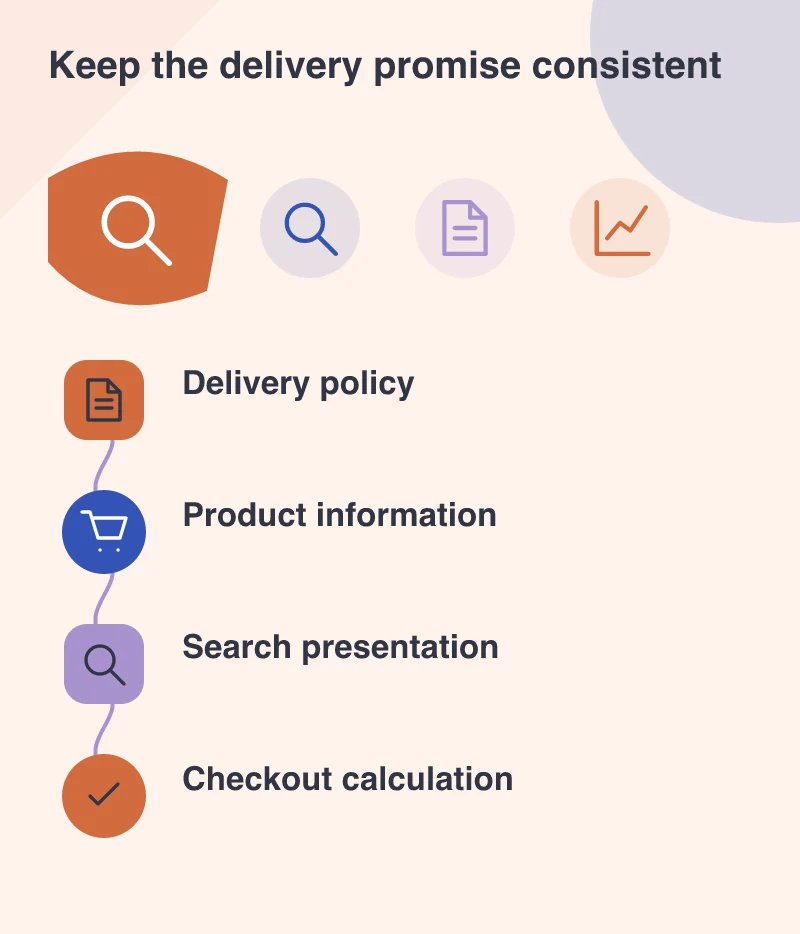
Map the information across systems
Check the product page, feed or markup and the checkout against the same test destinations. A postcode used by the development team may not reveal a problem affecting a remote area. Include an ordinary address, a restricted address and an order that qualifies for a different shipping rule.
When a discrepancy appears, find the source rather than correcting only the visible symptom. The commerce platform may calculate checkout correctly while a separate feed retains an older policy. A change log and a small set of reference examples make it easier to keep those representations aligned.
Review the question customers actually ask
Support enquiries can reveal which part of the delivery explanation is missing. If customers repeatedly ask whether an item can reach their area or whether several products arrive together, those are candidates for clearer page content. Search markup can carry structured details, but the customer still needs a readable explanation in the store.
September 2020’s development is best treated as a prompt to improve the offer itself. Make delivery terms understandable, test the rules against realistic orders and publish matching information where the relevant services support it. A search enhancement is useful when it helps a person arrive with an accurate expectation of the purchase they are considering.
Ask a colleague outside the project to explain the delivery offer after reading the page. Any uncertainty they identify is useful evidence that a technical configuration still needs a clearer human explanation.