

A headless storefront can give a retailer freedom over the customer experience. It can also leave the development team maintaining a private copy of somebody else’s framework. Following July’s PWA Studio 7 release, August is a useful moment to ask a practical architecture question: which parts of the storefront should express the business’s own requirements, and which parts should remain straightforward to update from the shared project?
Freedom includes a maintenance choice
PWA Studio 7 expands extension points across Buildpack, Peregrine and the Venia UI components. The release describes using those points to extend a storefront without duplicating and maintaining PWA Studio code. For a merchant, the significance is the potential shape of future work, rather than the internal names of the libraries.
A copied component may be quick to modify initially. The cost appears when the original component changes and someone has to compare both versions by hand. A defined extension point offers a more explicit relationship between the shared implementation and the store’s particular behaviour.
Begin with a requirement customers can recognise
Imagine a equipment seller that needs additional compatibility information on its product pages. The requirement is to help a buyer identify the correct part. It is not automatically a requirement to rewrite the entire product component. A developer can first investigate where the existing interface can be extended and which data must be made available.
That discussion should include the catalogue team. If compatibility data is inconsistent or absent, a new React interface cannot create reliable answers by itself. The presentation decision and the product-information decision need to be made together.
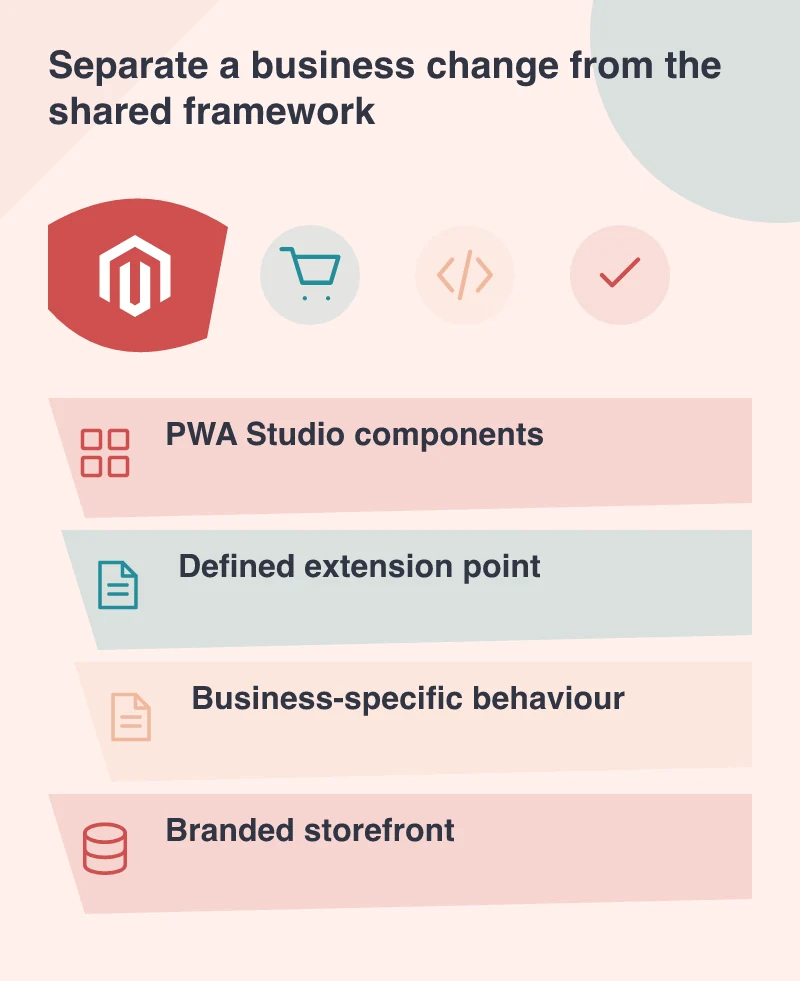
Write down the boundary
Ask for a short record of what the customisation changes, which extension point it uses and which package versions it depends on. Keep any unavoidable source copies visible in the same record. The purpose is not to ban custom development; it is to prevent an exceptional implementation from becoming an invisible dependency.
A useful review also asks how the change will be tested after an upgrade. Does a product without compatibility data still render? Can the editor correct the information? Does the addition remain usable on a phone? These questions connect the architecture to the customer and operational tasks it exists to support.
Judge headless work by the next change as well
The first launch is only one moment in a store’s life. New products, campaigns and integrations will create requests that the team cannot fully predict. A maintainable storefront makes those changes understandable without demanding a fresh interpretation of every copied component.
PWA Studio’s extension work provides one concrete way to have that conversation in August 2020. It does not mean every extension is compatible or every customisation is effortless. It does make the ownership question clearer: keep business-specific decisions deliberate, preserve a known connection to the underlying framework and ask how the next useful change will be delivered.
Keep a small demonstration of the custom behaviour with the handover. An editor or support colleague should be able to recognise whether it still works after an upgrade without reading the implementation.