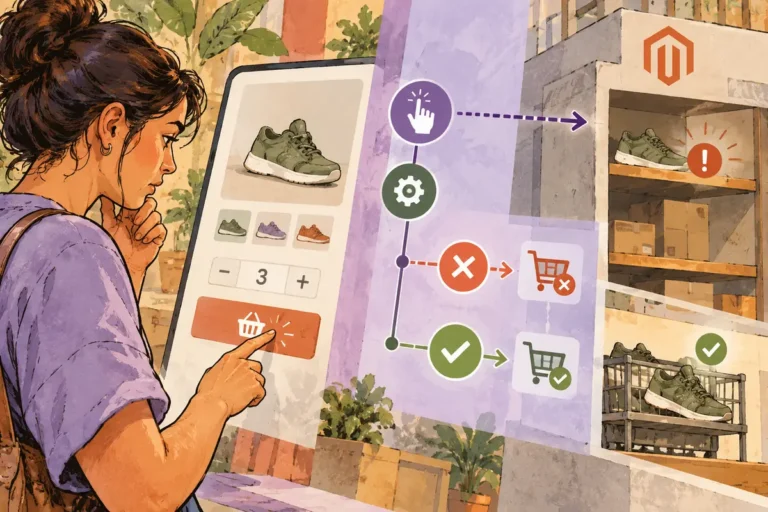

A headless storefront can make a form look simple while hiding several decisions behind its submit button. Where is the input checked? Which system creates the record? What does the customer see if the request succeeds but the next response is delayed? Next.js 14’s October release, with stable Server Actions, gives teams another way to implement that server-side boundary without removing the need to design it.
Keep the framework feature separate from the commerce rule
Server Actions provide a framework mechanism for server-side mutations and form workflows. They do not replace Magento’s pricing rules, customer permissions or order lifecycle. A headless application still needs to call the appropriate commerce operation and interpret its response correctly.
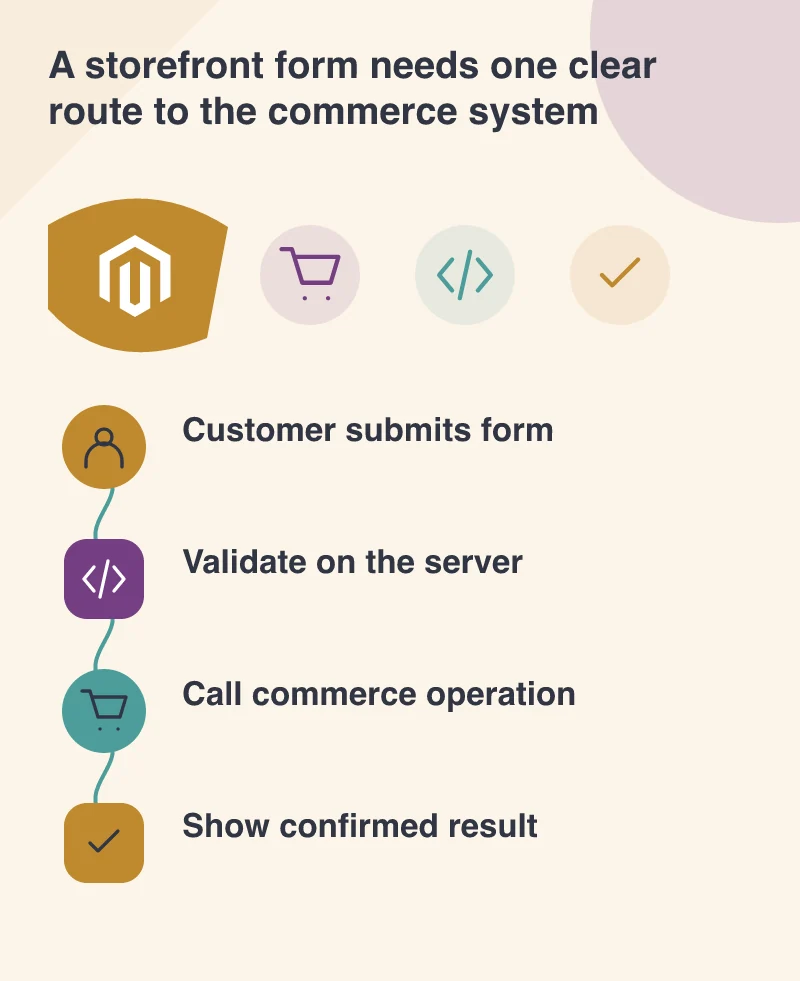
For an account form, the storefront can validate the shape of the submitted information before forwarding an authorised request. The commerce system must still enforce its own rules. Treat validation in the interface as a way to help the customer, not as a substitute for validation at the system that owns the record.
Show the difference between waiting and success
While a request is running, make its status visible and prevent accidental repeated submissions where repetition could create duplicate work. After it finishes, show the result that has actually been confirmed. A cheerful message produced before the backend has accepted the change gives the customer the wrong information.
Errors also need a useful destination. Keep field-level corrections near the fields, preserve appropriate input and provide an alternative when the problem requires staff help. A technical error response may be useful to a developer’s log, but the visitor needs to know what they can do next.
Revisit the cached information after a change
The Next.js release describes integration with caching and revalidation. In commerce, that is important because an account update or basket change can leave previously displayed information out of date. Decide which views need to be refreshed after an operation rather than invalidating everything indiscriminately.
A product page, a signed-in account and a basket do not all have the same sharing rules. Customer-specific information must not become part of a public cached response. Design those boundaries explicitly, and test switching between users on the staging environment so that a smooth first demonstration does not conceal an isolation problem.
Distinguish stable functionality from a preview
The same announcement presents Partial Prerendering as a preview. That label matters when choosing a production baseline. A team can explore it separately without making the whole storefront depend on a capability whose status is still experimental in this release.
The framework choice also commits the team to an architecture and a division of responsibility. Start with one form, trace the request into Magento and back, and test retries, validation and refreshed state. A headless build earns its flexibility when the customer sees a reliable result and the team can explain which system is responsible for every step.